

It shows what can be done for owls whose habitat is destroyed
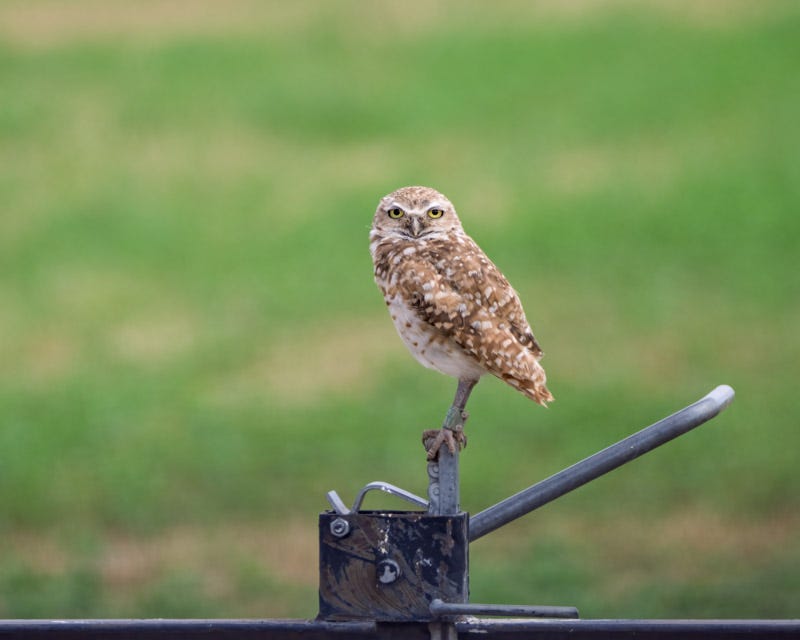
The Martin Farm, situated along the lower Santa Cruz River, was purchased by the City of Tucson in 2009 as part of a Riparian Restoration initiative setting aside a number of plots of land along with several public and private entities. The goal for all of these acquisitions was both riparian restoration and groundwater replenishment. This particular property was then made available to Wild at Heart to establish a safe haven for displaced Burrowing Owls. Wild at Heart is an Arizona-based raptor rescue program and one of their initiatives is a Burrowing Owl Relocation Project. A major ongoing threat to Burrowing Owls is habitat destruction due to urbanization. To counter that, Wild at Heart rescues, relocates and releases endangered birds into locations such as the Martin Farm where artificial burrows have been created among farmland and other supportive natural environments. On a recent visit, I saw one of the Owls that had been brought to the Martin Farm complex. Later, I’ll share a bit more about that Burrowing Owl, pictured below on the handle of an irrigation gate in nearby farmland.
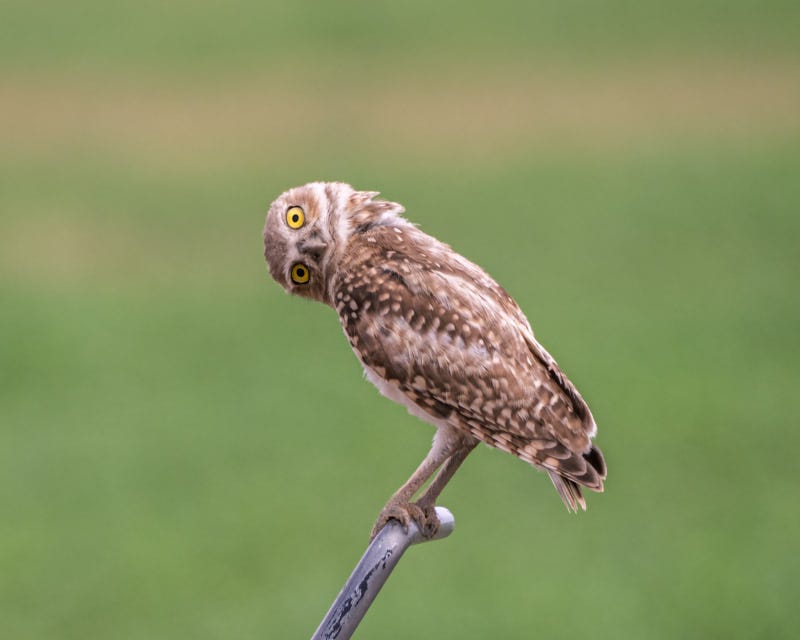
Another Burrowing Owl, a juvenile, was perched on a different nearby irrigation gate handle. This photo tells you all you need to know about why Burrowing Owls are so endearing. Besides being a species that is active during the day, they are eternally curious about their surroundings.
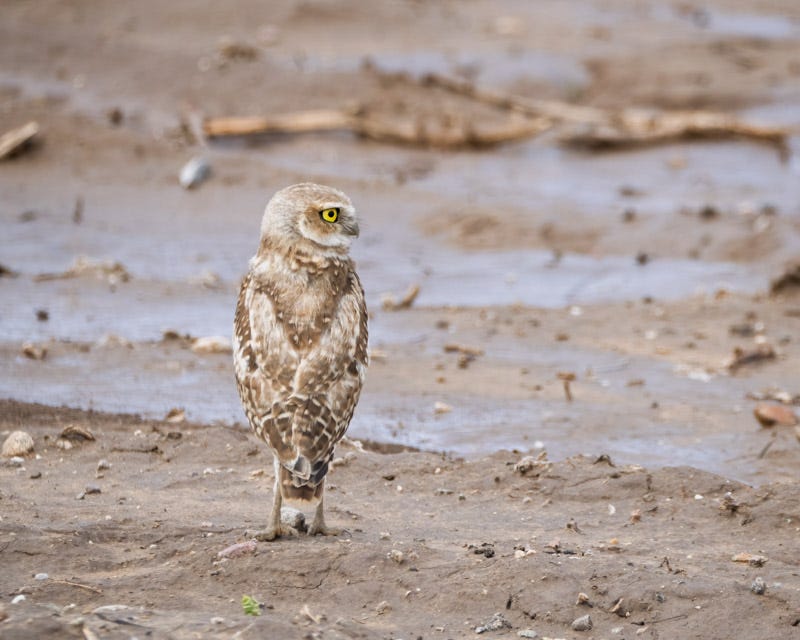
I observed this Owl from inside of my car while parked alongside the farm road. These owls, living in burrows adjacent to irrigation ditches, are used to plenty of farmland traffic along the road. After a while the Burrowing Owl flew over my car and landed in a nearby farm field that was wet from recent rains. I imagine it might have been looking for any unsuspecting insect.
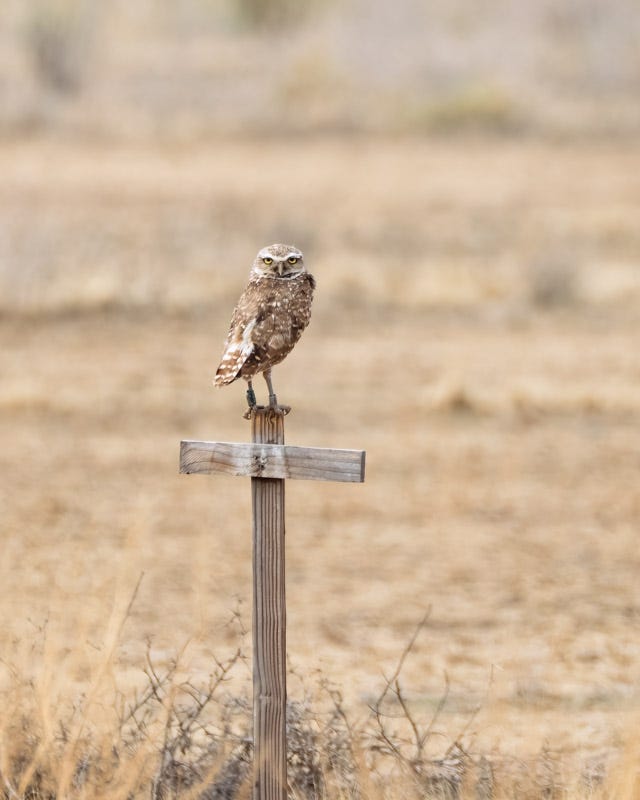
I drove down the road to get to the Martin Farm. There is “no trespassing” posted at the location but you can view the property from outside the fence and along the road. Wild at Heart has built and continues to use dozens of artificial burrows there. You can read about the process here and here. Once Owls are placed in the burrows, the “address” is noted and a sign is placed there. That sign offers a nice perch, high enough for the Owls to monitor their entire landscape for both prey and for predators.
Here is another burrow with one Owl at the entrance to the burrow and another hanging out. That green plant behind the burrow is Russian Thistle, aka tumbleweed.
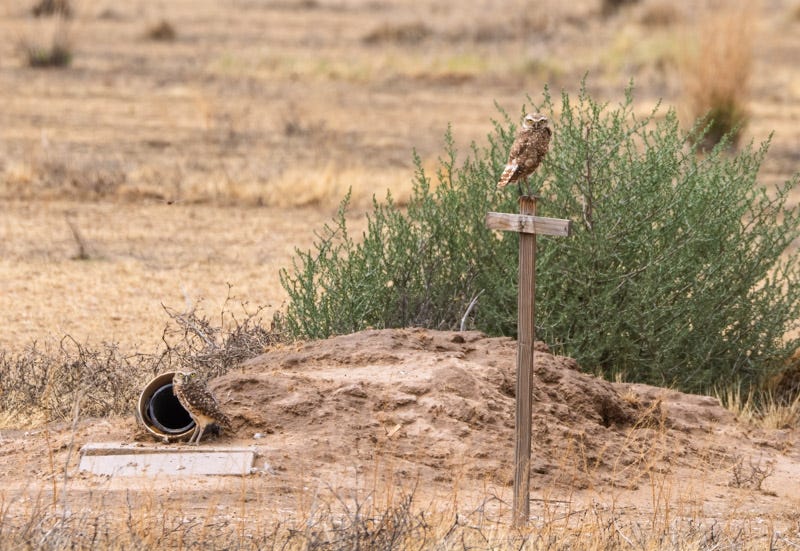
Many individuals and groups have volunteered to assist with Wild at Heart when there is a new group of Burrowing Owls being released. Pima Master Naturalists have helped for some years and report on their work here. Once the releases are complete of course, the Owls can choose to remain in those burrows or leave to inhabit other available spots along the extensive farmland in southern Arizona.
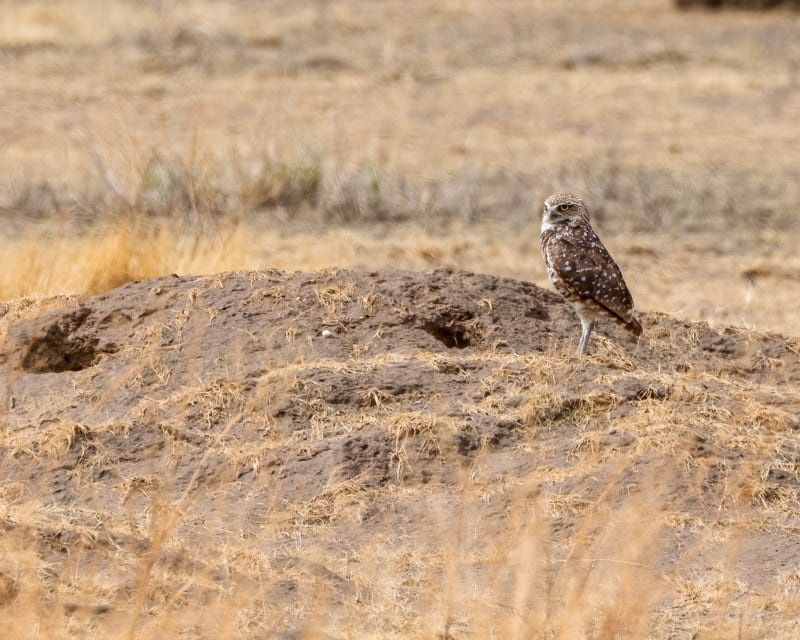
The morning I visited was on one of our area’s recent, heavily overcast mornings. Many of the Burrowing Owls were taking advantage of the relatively cool temperatures (meaning well below 100°) to be outside of their burrows. Here is yet another short report by the Pima Master Naturalists from another year of their service.
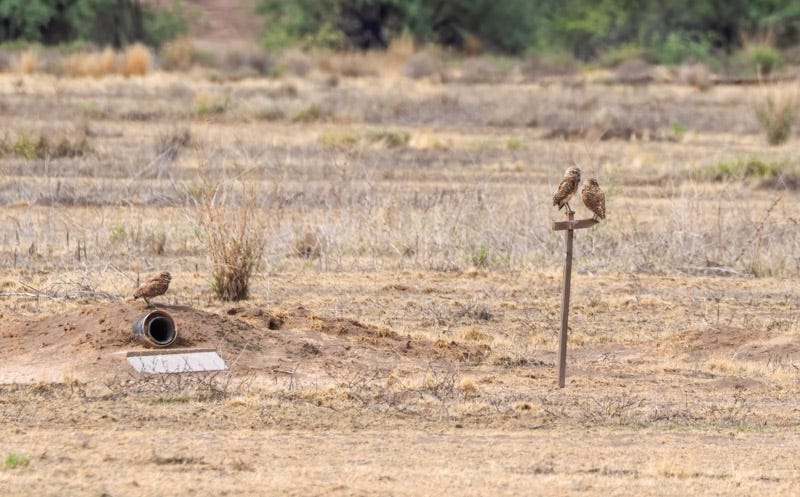
Although the burrows were perhaps 50 yards away, I had nice looks at the Owls. While watching the birds at the burrow in the photo above, the Burrowing Owl standing on the home’s entrance decided it wanted to find another spot to hang out at. It took off.......
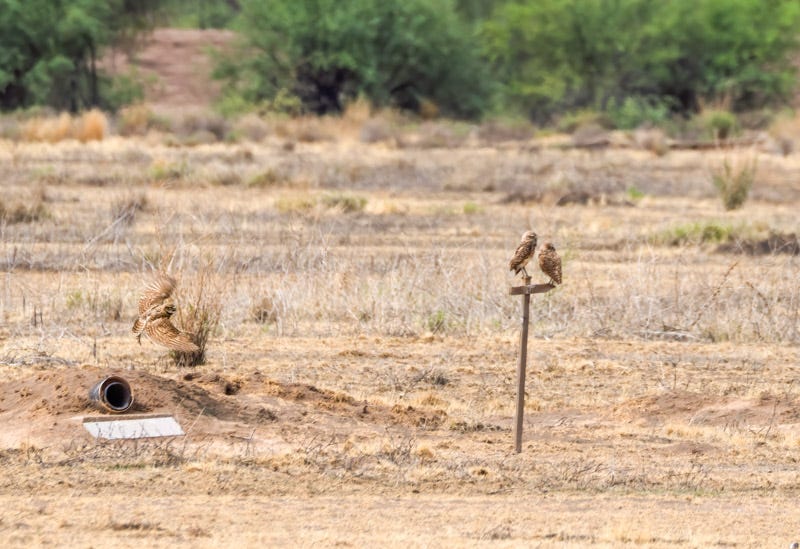
...and landed behind a patch of grass a short flight from its burrow.
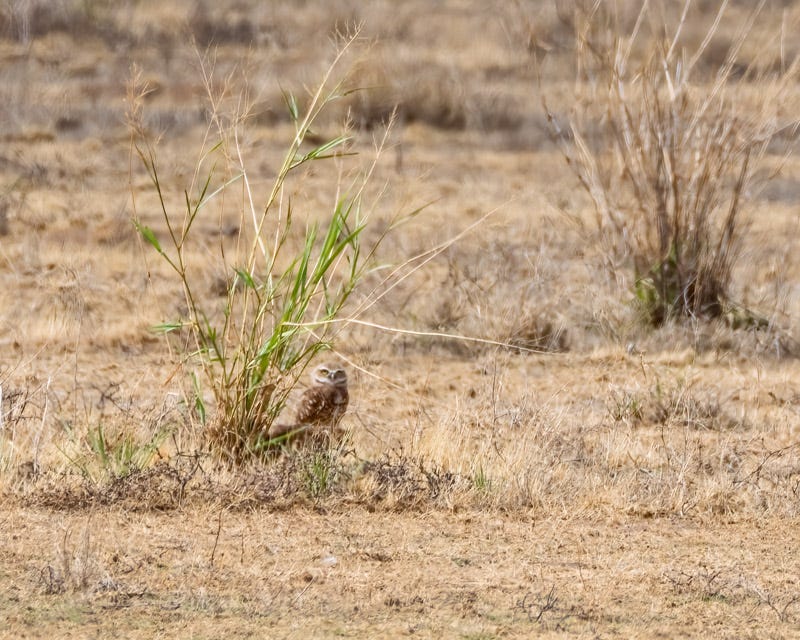
On my way out of the area, the family of three Burrowing Owls that I had first seen along the roadside were still in the same spots. You may have noticed that the Burrowing Owl in the first photo of this post was wearing some ‘jewelry’. This is a close-up of that same bird taken on my drive out of the area. These Burrowing Owls are banded when they are first rescued. This is done under the auspices of the USGS for all birds that are trapped for research in the United States. Audubon also provides us background to why and how birds are banded.
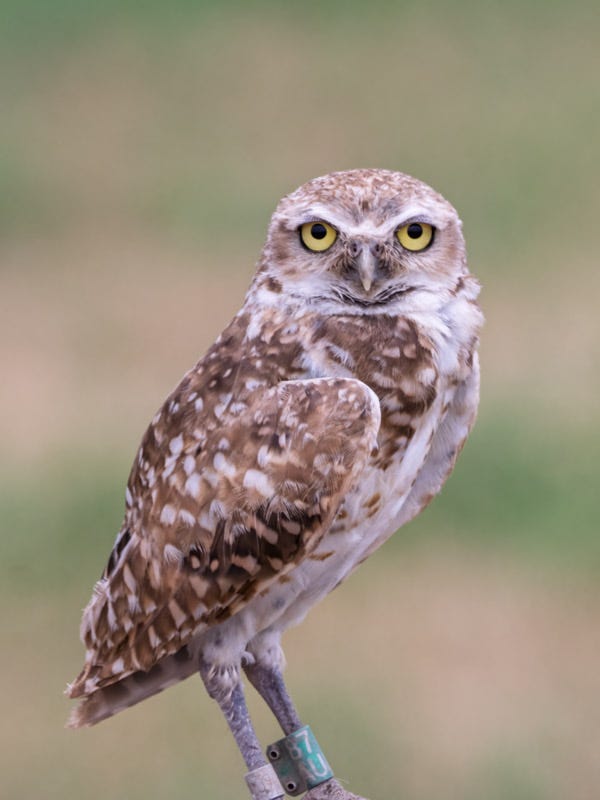
This particular Burrowing Owl is wearing a green band on its left foot with the numbers 87/AU and a silver band on its right foot. I sent the numbers in to Wild at Heart and learned that this Owl had been rescued from the Harquahala area northwest of Phoenix. It was released (”put in tent 2”) on 9/20/25. Apparently it has made a good life for itself, moving about a half mile or so east from its release spot at the Martin Farm and finding a partner at a nearby farm. The three Owls- 87/AU, the juvenile in today’s photos, and another adult- all have been seen a number of times in that exact same spot.
You can learn more about Burrowing Owls from this Tucson Bird Alliance piece.
Wonderful to hear and see! Burrowing Owls doing ok in Tucson area - here in UT we’ve had many abandoned nests due to drought.
I’ve ordered “Owls of the Eastern Ice” that chronicles a 5-year effort to conserve the Blakiston’s fish owl … the world’s largest owl. Complete 360-degree contrast to our environment. Can’t wait to get it.