

A great location for a large owl to nest in
I became aware of one Great Horned Owl family in a saguaro cactus early in April this year. Usually these Owls will claim the nest built by a large bird in a past year for their nesting site. By nesting earlier than most other local bird species, a Great Horned Owl can move onto a nest before last year’s bird realizes its loss. However, Great Horned Owls may also accept a wide variety of flat or bowl-shaped surfaces for a nest site. A saguaro cactus that has lost its central trunk offers a very nice bowl for a Great Horned Owl to nest in. I first visited this nest on April 11. Mom was there with three young Owlets.
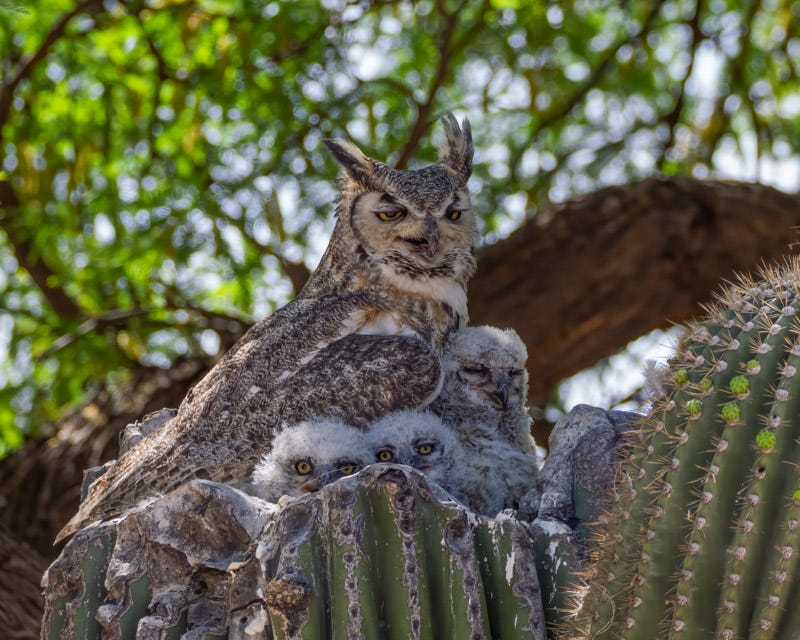
Great Horned Owls are generalists and live in a wide variety of environments including urban and suburban areas. This nest was in a very busy retirement community north of Tucson and this is the fifth year in a row that the Owl has chosen to use this nest location. Needless to say, an Owl in a location like this gets an extraordinary amount of attention. The homeowner had posted this sign in the front yard of her home:
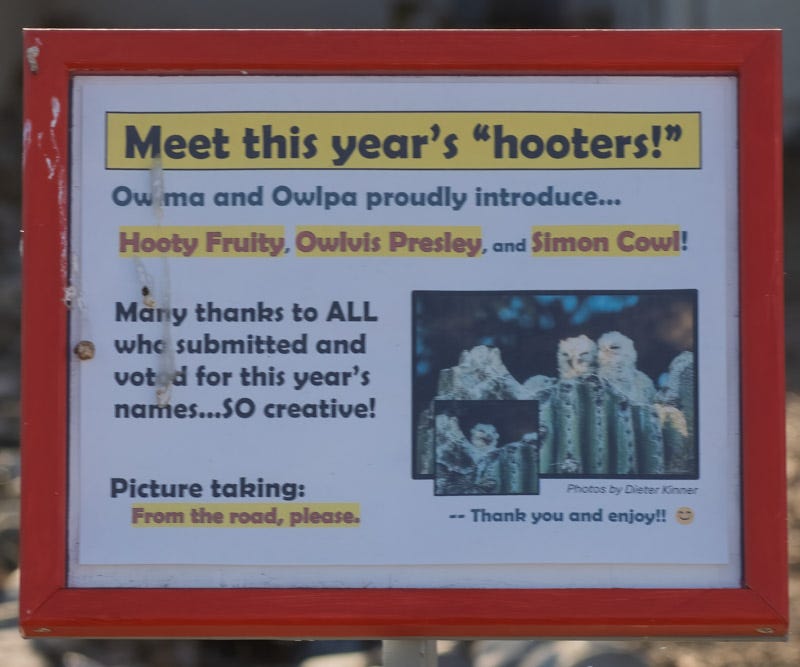
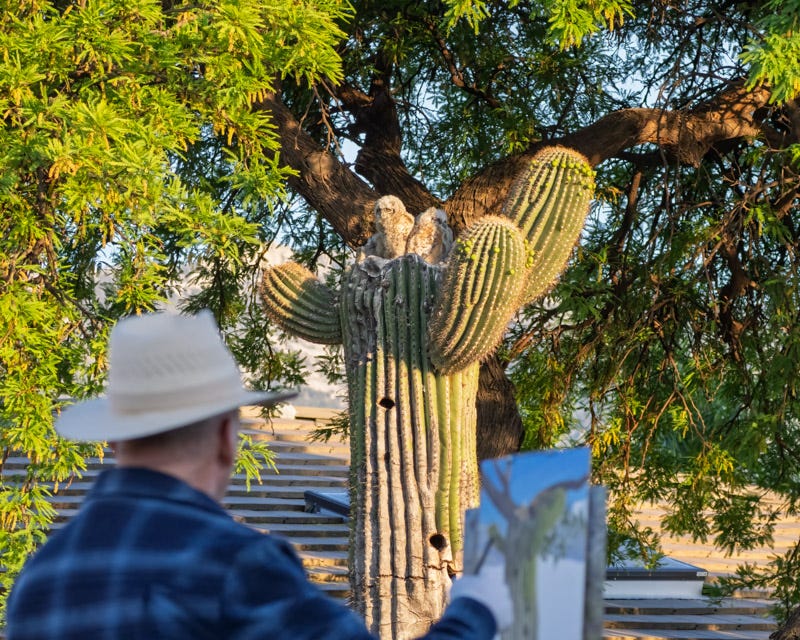
In this heavily populated community, onlookers and observers stopped by constantly to check out the nest. During each of my visits to the nest lasting perhaps an hour, there was a steady stream of cars and golf carts swinging by the street with people stopping to take cell phone photos and videos of the owls. These birds were celebrities! One day we saw a fellow from a neighboring community standing in the bed of his pickup truck, inspired to paint this special occurrence.
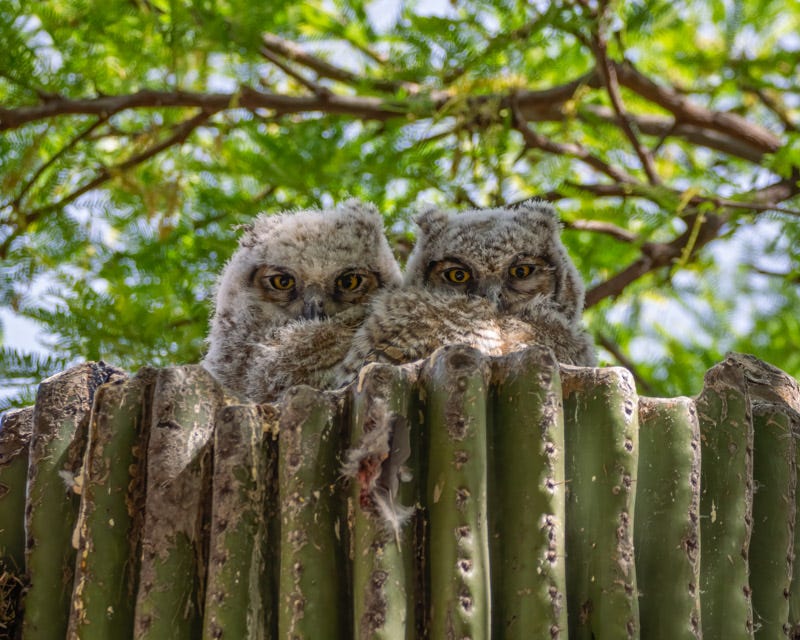
Two weeks later and the Owls had grown quite a bit. Mom was no longer in the nest. It was too crowded and I imagine the Owlets would be nagging her for food and attention if she were there. The young Great Horned Owls were growing in feathers, including the first hint of those tufts on their head that give the birds their name, Great “Horned” Owls. Sometimes those feathers are referred to as “ear tufts” because they remind us of the ears of some mammals, but those feathers have nothing to do with the Owl’s hearing. Those feather tufts primarily are there as camouflage to break up the bird’s silhouette during the daytime.
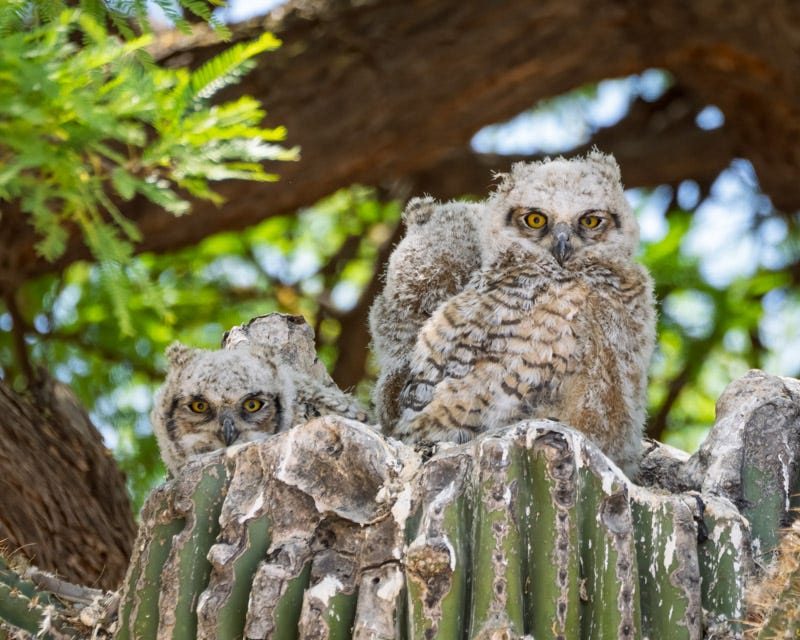
A few days later and there were only two Owls in the nest. The homeowner let us know that one of the young birds had fledged and made it into her backyard, perching nicely in a tree there. It was close enough for the Owl’s parents to watch over it and take care of it until it learned to fly.
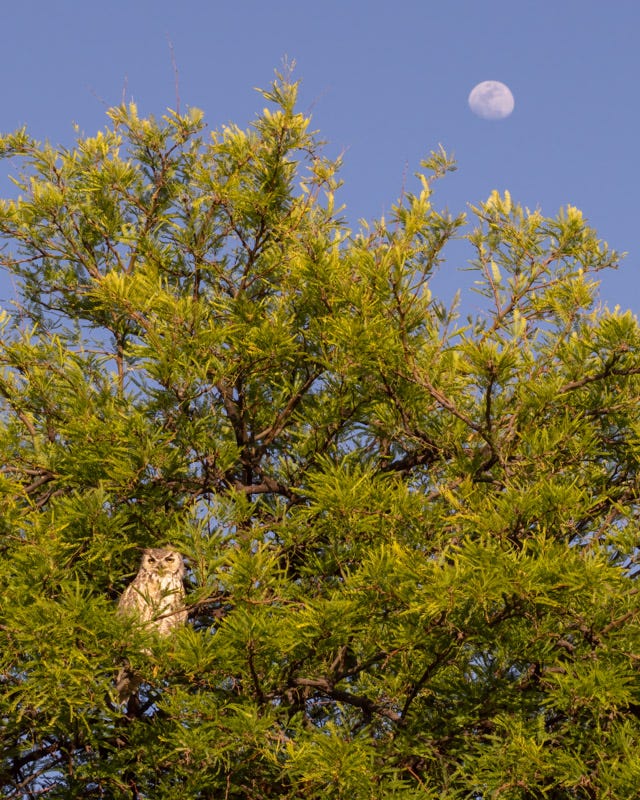
At that point, the mother Great Horned Owl spent her days in the mesquite tree that served as an umbrella for the saguaro nest. Most of the time she was hidden from street view but on one occasion, she was perched out in the open facing the setting sun. The father Owl was nowhere to be seen. Typically, the father Great Horned Owl spends its days away from the nest tree, but within earshot and probably line of sight to the nest.
By April 27, a bit over two weeks from my first visit to the nest, the two Owlets remaining in the nest had developed more and more of their flight feathers. Their black facial disc was now very apparent.
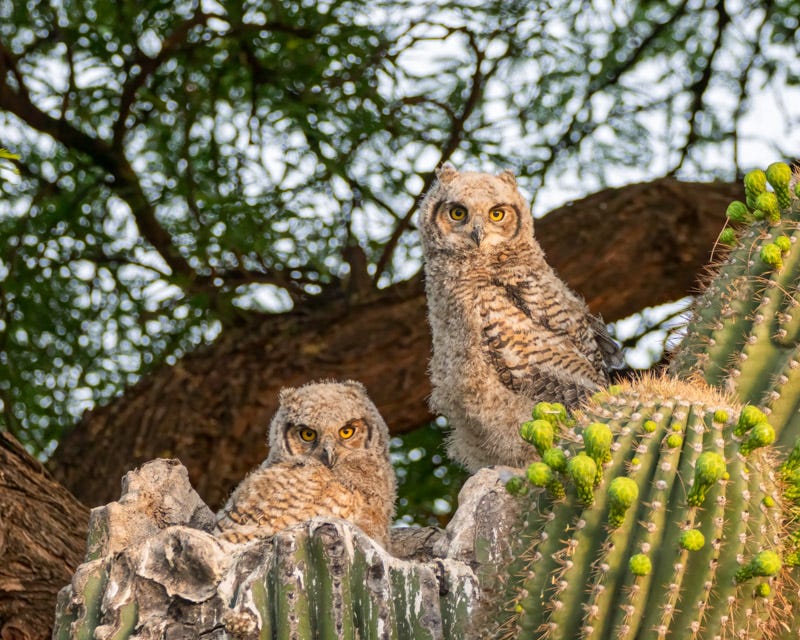
I returned on May 3rd and all of the Owls were now out of the nest. The Owlet in the backyard had returned to the front yard! They had fledged but all three remained close to the nest under the canopy of the mesquite tree alongside their saguaro nest. It’s likely these birds were not yet able to fly.
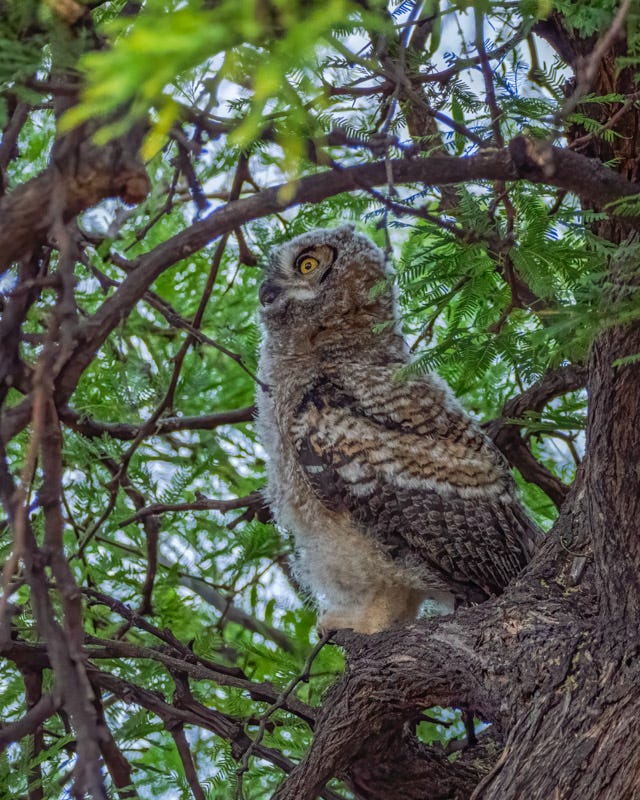
Two of the Owlets were visible in the open. They were waiting for the sun to set so that Mom and Dad could begin the night’s routine of delivering food to these hungry young birds.
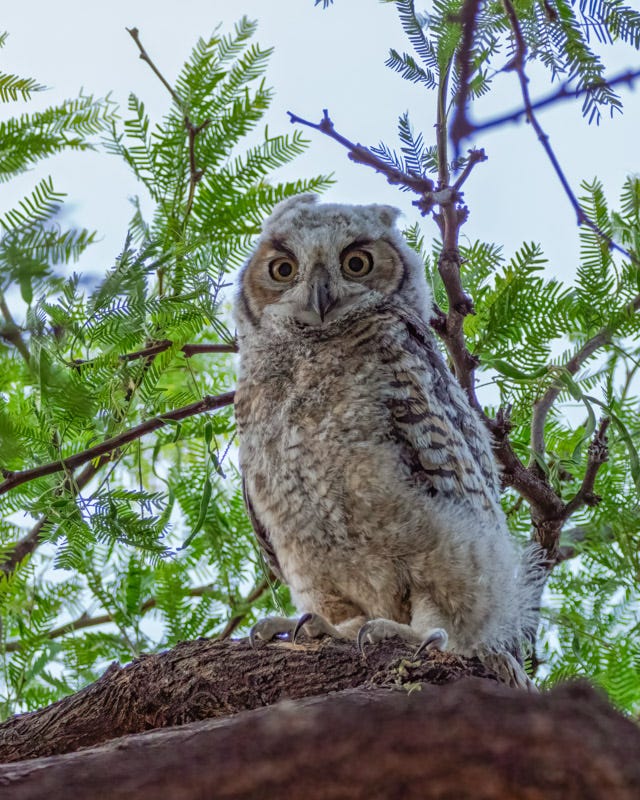
While the birds did not show concerns about my presence, I knew this would be my last visit. These birds were ready to head out in the world. The third Owl was tucked in behind a jumble of branches so I didn’t get any shareable photos of it. That third one did appear to be the youngest of the group.
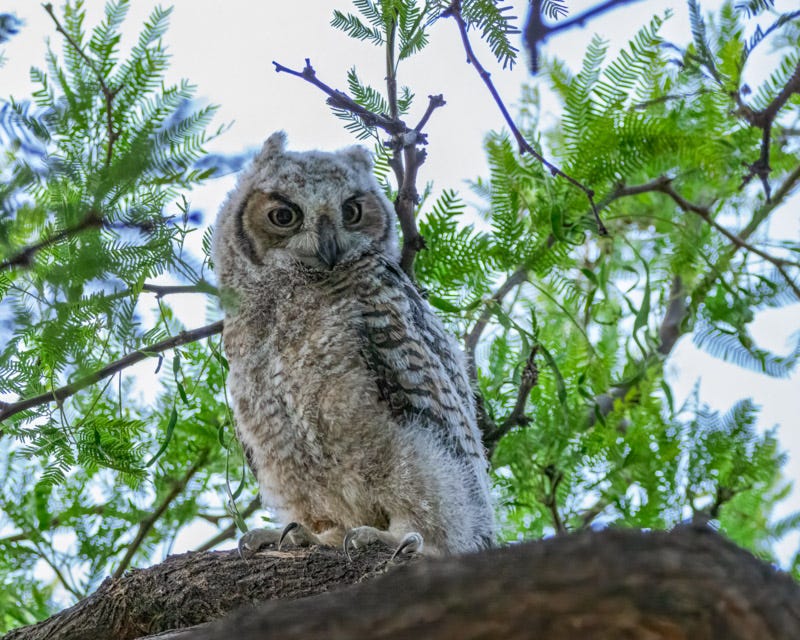
Over the next few months, as the birds begin to fly, the parents will continue to provide food for them. They will begin to learn to hunt but are still dependent on the parents for several months. At the same time, new adult feathers will grow in over the first half year of their life, pushing out all of the juvenile feathers that allowed the birds to leave the nest and get around the neighborhood.
It is tough to survive in nature. Studies have shown that about 50% of young Great Horned Owls die before their first birthday. Starvation and injuries occur during that year and these inexperienced Owls can have a tough time making it in the world.
To observe Great Horned Owls during nesting season, you can follow two local nest cams. By now, perhaps only videos are available as the Owls may have left their nests. One Owl Cam is at Ventana Canyon and the other is in Saddlebrooke.
Great story Dan, we don't realize how difficult it is to be born out in the wild and survive dependent the abundance of food or whether or not your parents stay healthy.
Here in southern Arizona, I see them hunting after the rain. Beautiful story, thank you for posting.