

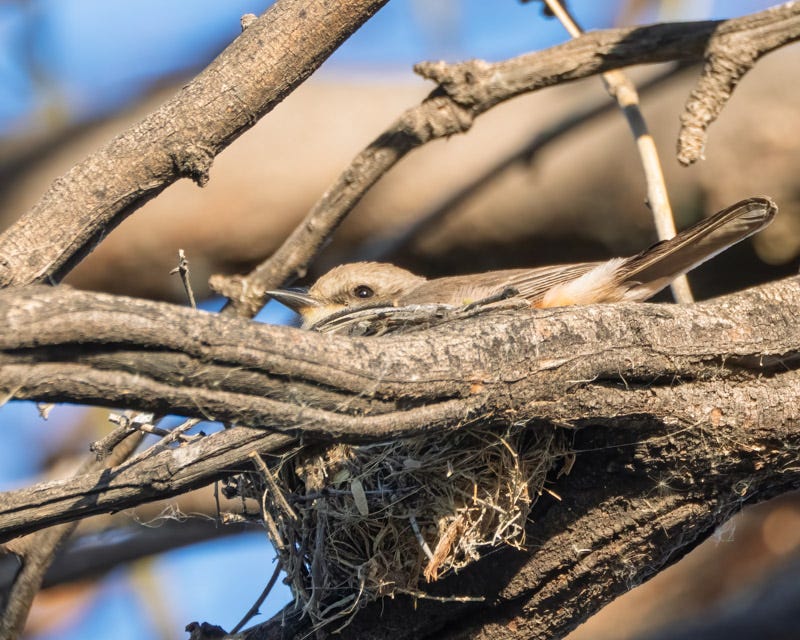
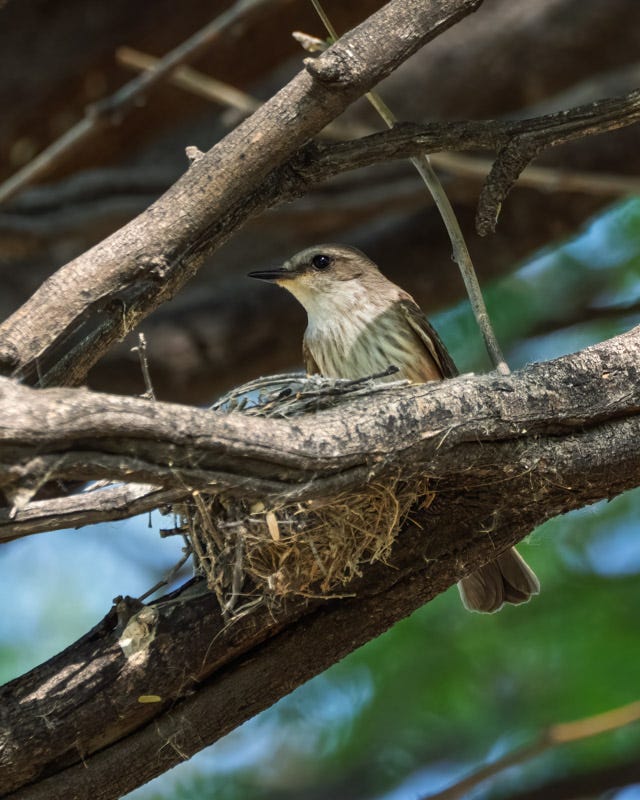
Vermilion Flycatchers are very conspicuous birds that are easily seen in each of Tucson’s parks and fields. However, during breeding season, the Flycatchers build inconspicuous nests that go very unnoticed. I learned about a nesting Vermilion Flycatcher that was in one local park. In the middle of March I saw the female sitting in her nest.
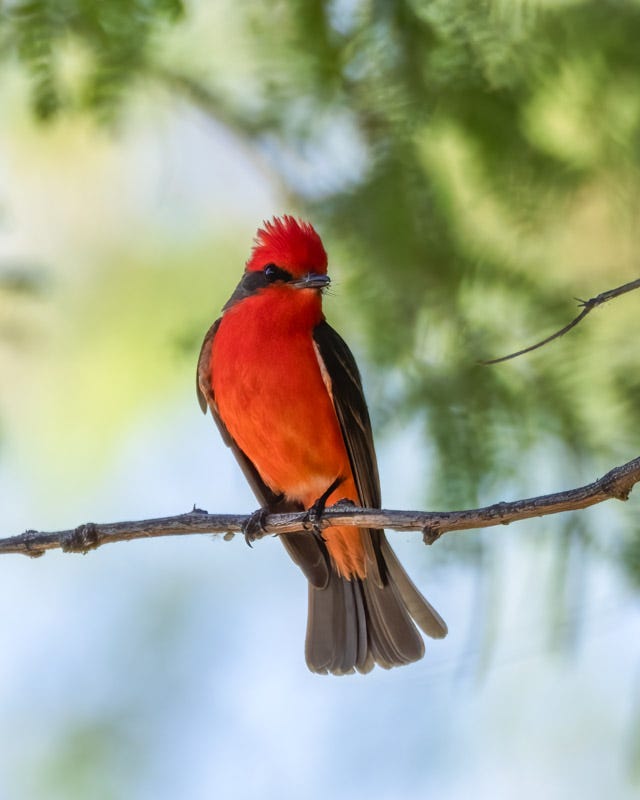
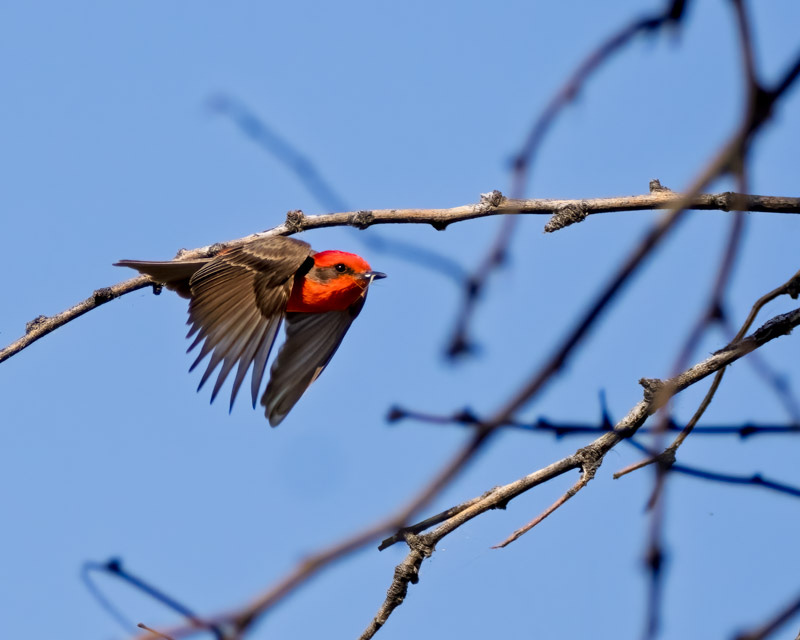
I returned two weeks later at the end of March and was able to watch the male and female birds bringing food to the hatchlings in the nest. Here is the male Vermilion Flycatcher with a very small insect in his bill. When I first arrived at the nest site he was nowhere to be seen. After ten minutes, he showed up and slowly flew from perch to perch, approaching the nest.
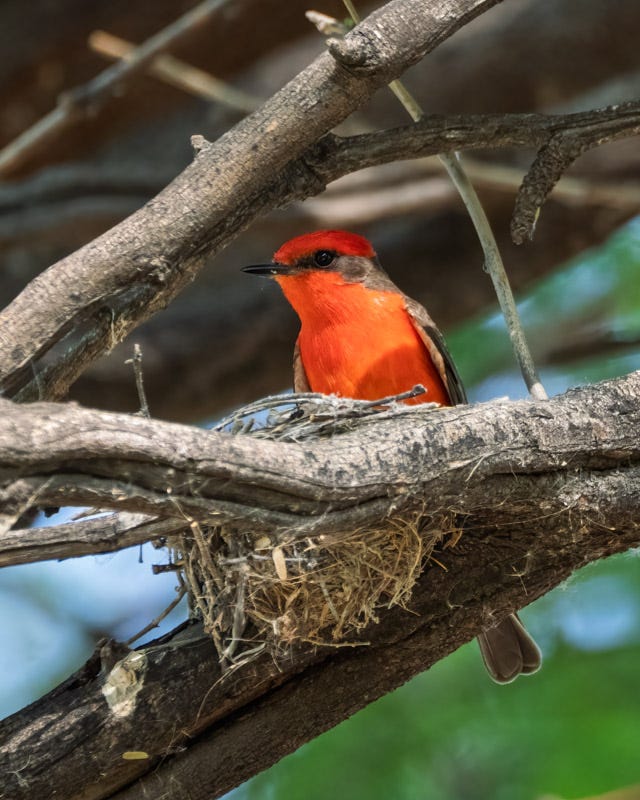
As soon as he flew to the nest, he immediately fed the young. The nest was too high in the tree for me to see how many hatchlings were in the nest.
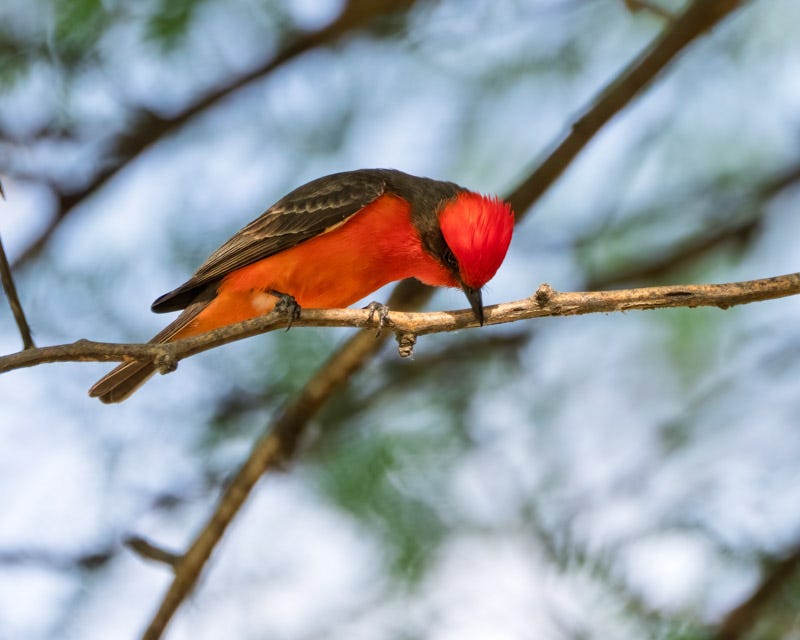
Once he flew away from the nest, he cleaned his bill. Birds will often care for their bills this way. The method is called “bill wiping” or “feaking” and serves to both clean the bill as well as to maintain the shape and edges of the bill.
When the young birds have grown some feathers and are able to regulate their own body temperature, the mother bird will then begin to forage for food. This female Vermilion was just as busy hunting for food as the male was. Vermilion Flycatchers feed their young a high protein diet comprised of insects.
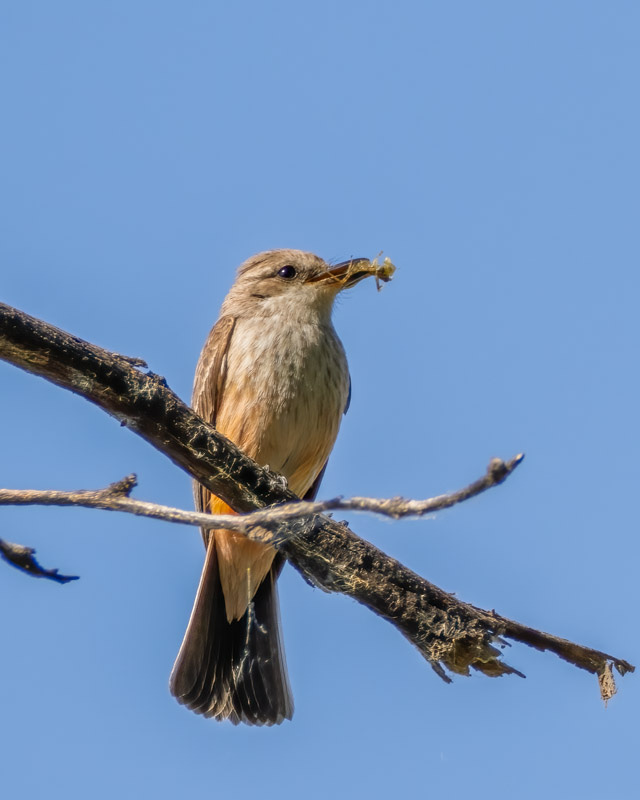
She, too, delivered the food to the young birds and then flew off in search of more.
At one feeding time, I noticed an interesting behavior. The male flew to a nearby perch, and then flew directly to the nest with an insect in his beak.
This time, after feeding the young he lingered. I wondered what he was doing. You may notice that his beak is slightly open.
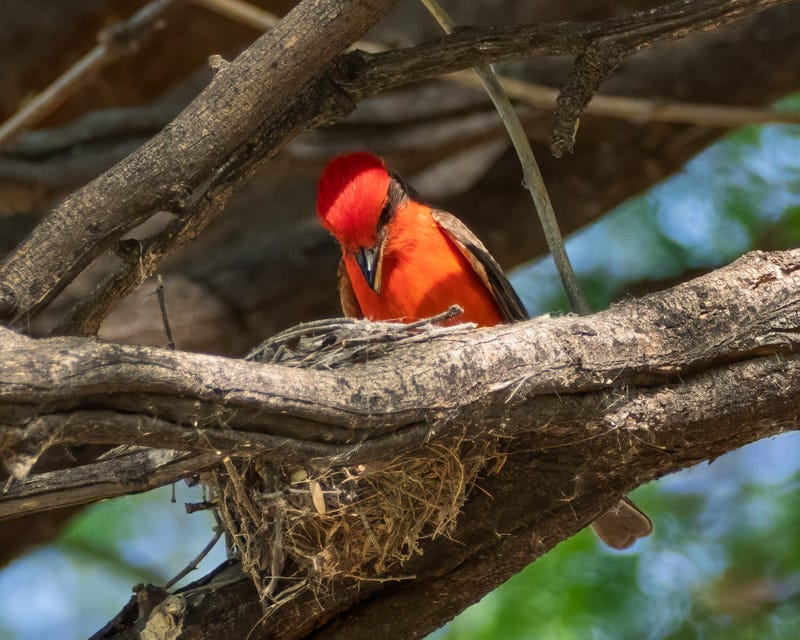
Young Vermilion Flycatchers are very helpless like many newly hatched birds. During those first few days, they will poop within seconds of being fed. The parent bird will wait, and then grab the fecal sac and fly off to deposit it elsewhere. This maintains the cleanliness of the nest but also removes the white fecal matter which might otherwise attract predators.
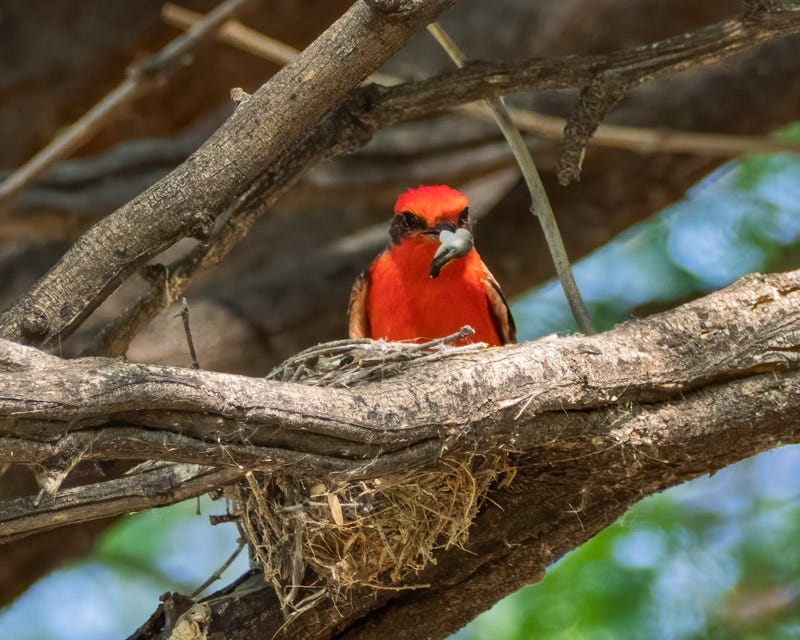
And off flew the parent. He’ll drop that fecal sac off somewhere and then resume hunting.
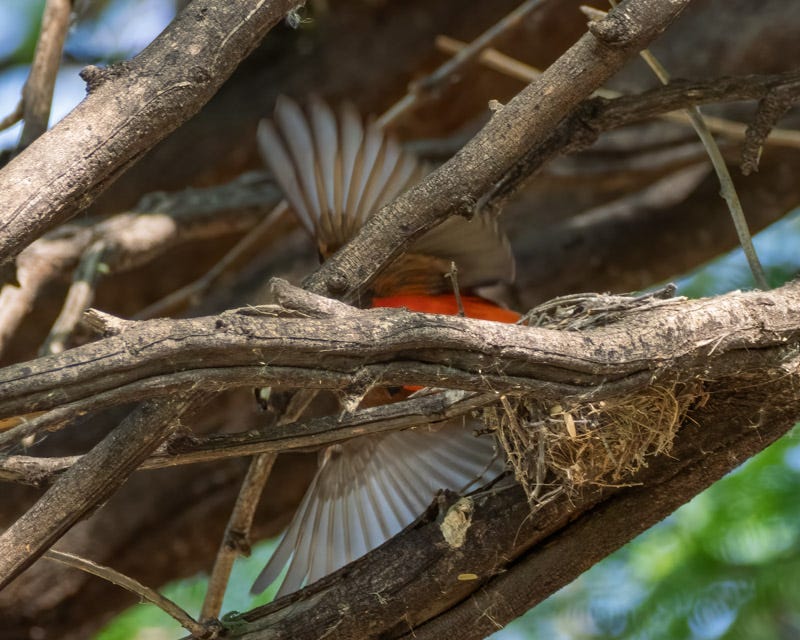
This cycle of feeding the young will repeat itself over and over again. The young birds will fledge (leaving the nest) in about two weeks. The parents continue feeding the fledglings for another few weeks. Often during that time, the male assumes full responsibility for feeding the young while the female may begin initiating a second brood of Vermilion Flycatchers.
Thank you to Anne L., Jim S., Mary C., Patricia D., Michele and Reuben W., Alexa V., Danny G., Karyn Z., Anna Marie and Joey D., Jeff A., and Ellen S. for your donations to our Birdathon efforts. Our Birdathon team “Birdies, Bogeys, and Eagles” is raising month for the Tucson Bird Alliance. You can read more about it on our Birdathon page here. Donations will be continue to be accepted throughout April. If you do wish to donate, please remember to list our team name. Thank you!!
So interesting to learn the habits and such beauty in the males feather colour! So vibrant. Great pictures! Thankyou😊
Beautiful photos and explanation of how the parents take care of their babies.