

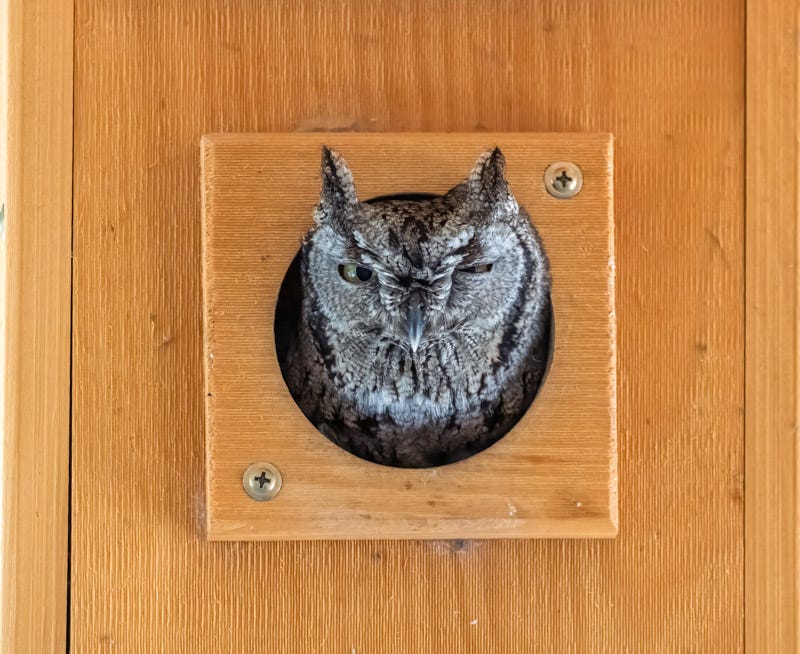
My regular readers know that I have ‘hosted’ a family of Western Screech Owls in a nest box during breeding season for many years now. This is the third year that the Owls have used the “new” nest box on my back porch. I placed the box to face my kitchen windows so I could view them from the comfort of my kitchen. Here is a picture I took of the female on May 3, when she was resting in the opening to the nest box. I was standing in my kitchen and she was facing me from perhaps just 8 feet away.
A quick timeline: The Screech Owls began using the box very regularly by February. Changes in the Owl’s behavior shortly afterward made me think that nesting/egg laying behavior had begun and on March 14, Hawk Watch International began monitoring the nest box weekly. Using a handheld camera on a long stick, a HawkWatch volunteer would take a one-second video of the inside of the nest box. On April 4, 3 eggs could be seen. On April 25, one fuzzy Owlet was visible in the one-second video. Two weeks after the first owlet was seen, four baby Owlets were seen as they continued to grow rapidly. Between the tight space in the nest, babies begging for food, and the increased Tucson heat, it wasn’t long before the mother Owl began spending time outside of the nest box during the day. On May 9, I found her under the porch at midday.
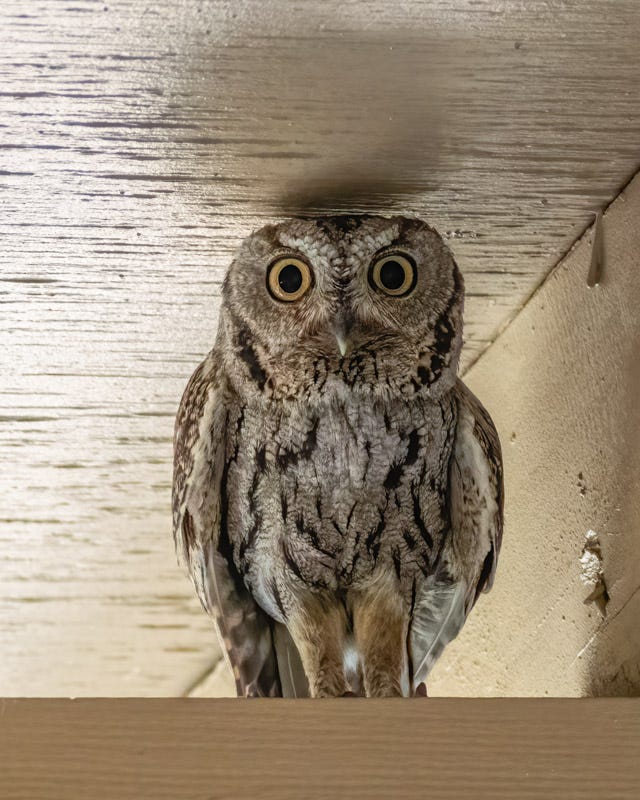
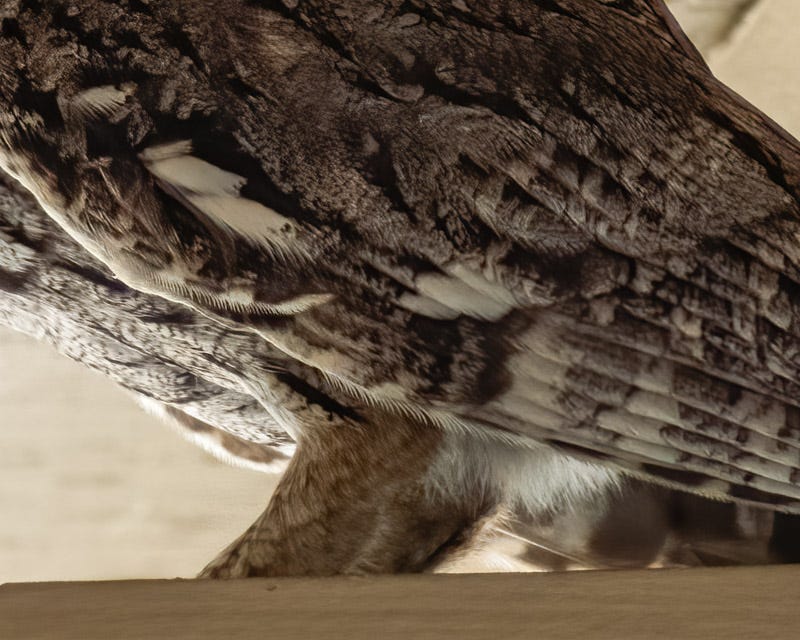
There was barely room to stand, but it was cooler and breezier under the porch than in the now crowded quarters of the nest box. Mom still tried to get some sleep during the day. She saw me, but figured my presence was not a risk at this time. If she had been worried, she would have raised the feather tufts on her head. She is spreading her wings to help to cool her body.
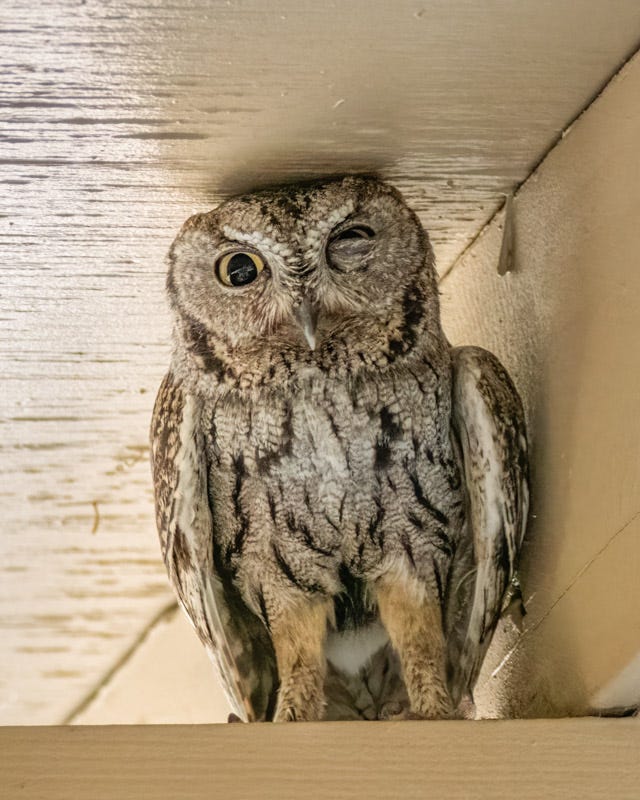
She figured I wasn’t much of a threat and turned to rest again.
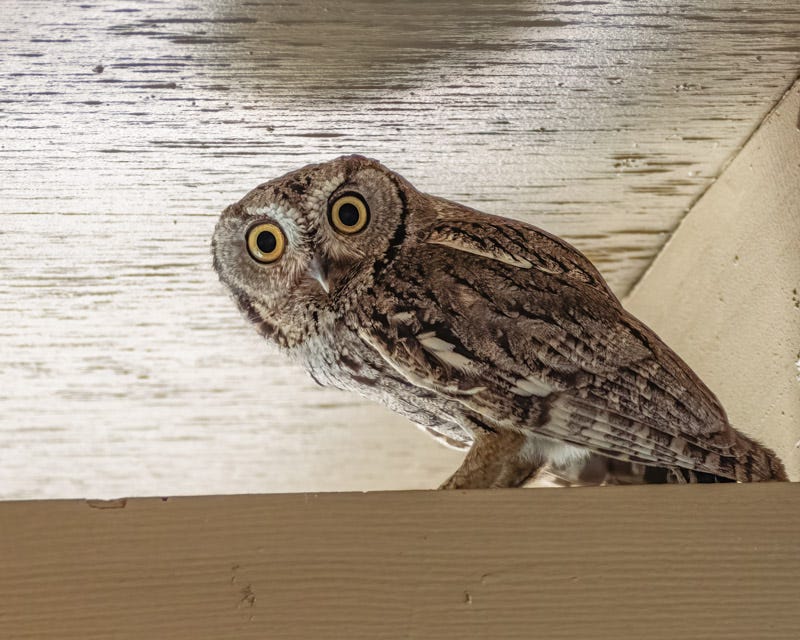
In that position, a close look at her wing feathers revealed the comb-like structures on the leading edge of each of her flight feathers. That feature breaks up the air turbulence as she flies, helping to lessen the sound of the wind enabling the silent flight that Owls are known for.
Two days later I walked out on the porch without looking for the birds. The Owl, which had been perched on the ledge outside of my kitchen window, was startled and flew into a nearby jojoba plant. Once she landed there, two Curve-billed Thrashers began screaming at her from outside of the jojoba bush. Her raised feather ear tufts let me know she was extremely alert and on edge. Those feather tufts can help to camouflage the owl by breaking up her silhouette and helping her blend into the surrounding tangle of branches.
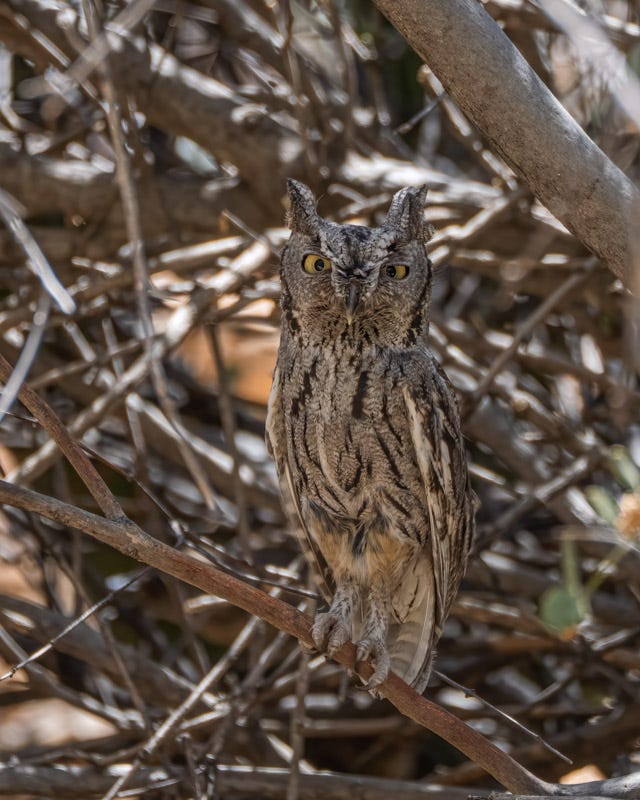
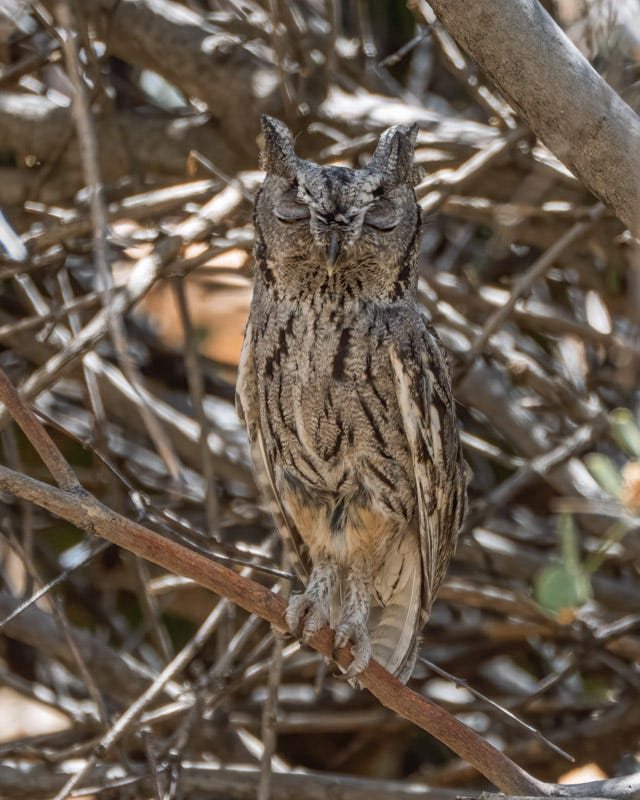
It didn’t take long for her to calm down again and begin to continue her daytime nap. She was still alert, but half asleep as well.
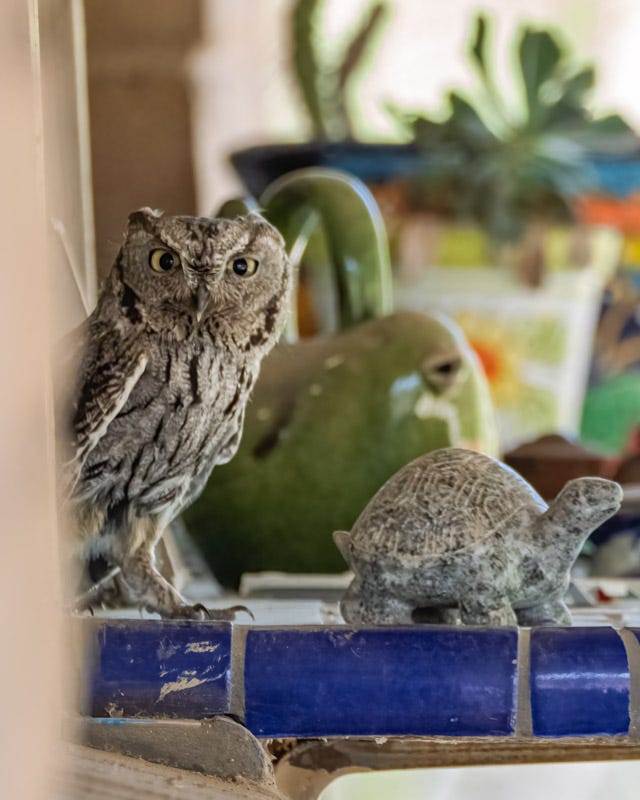
Two days later when I arrived at home just before noon, I thought she might be on the patio again and snuck around the house to check . I saw the Western Screech Owl taking advantage of my open kitchen window and the cool air that was blowing out from inside the house.
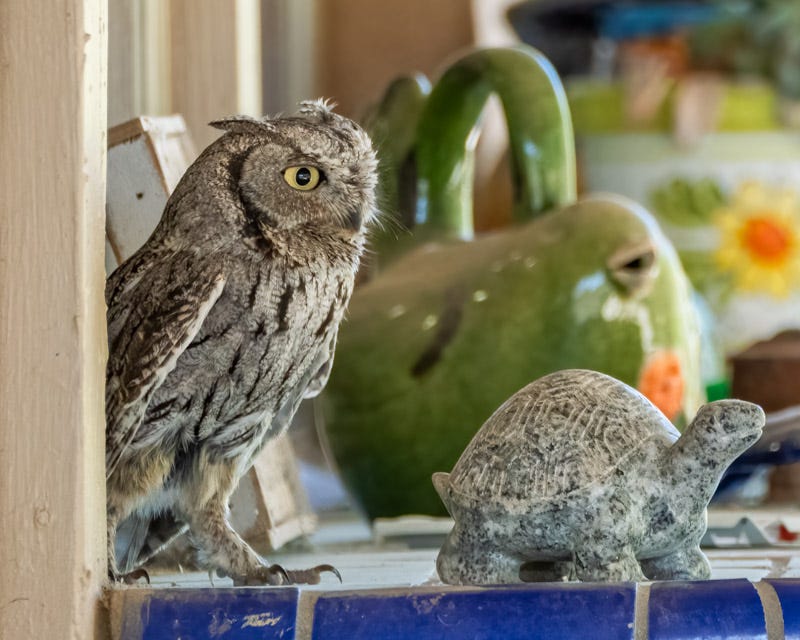
She appeared a bit concerned, but quickly returned to her relaxed pose and I walked away and headed into the cool house myself.
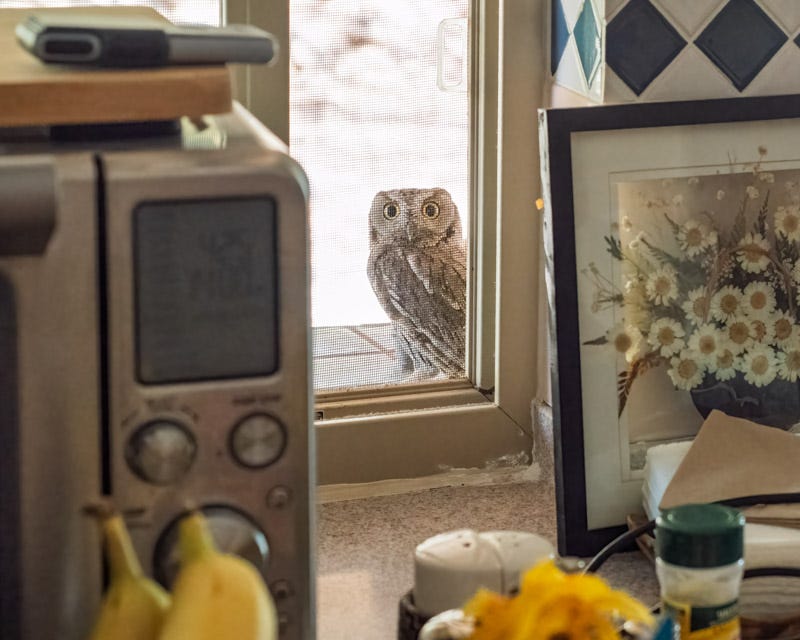
An hour later I noticed her in the same place, taking advantage of the cool air. It was interesting because when I watched her while I was outside the house, she didn’t seem to mind. When she spotted me looking at her from inside the house, she was either more concerned or more cautious. She flew off quickly.
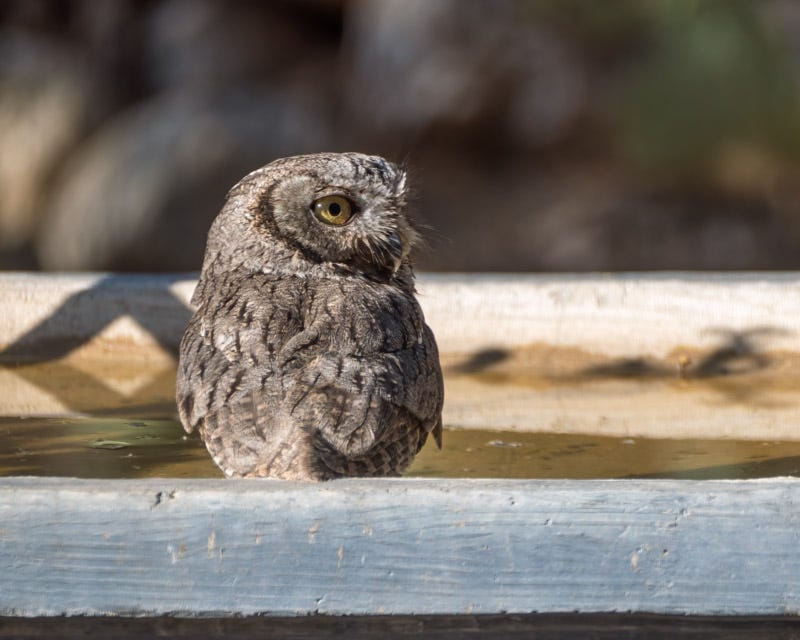
Four hours later and the Owl had found yet another way to stay cool in our increasingly hot days. I saw her resting in the bird bath, cooling off.
A few days later, the team from HawkWatch International came over to band the birds. I will follow up with more shots of the parent birds and some shots of the little ones.
The mom seems to consistently wink at you- she’s thanking you for the cool air,
How fun to have the owls so close and comfortable with your presence. I would be constantly watching them to see what happened next!