

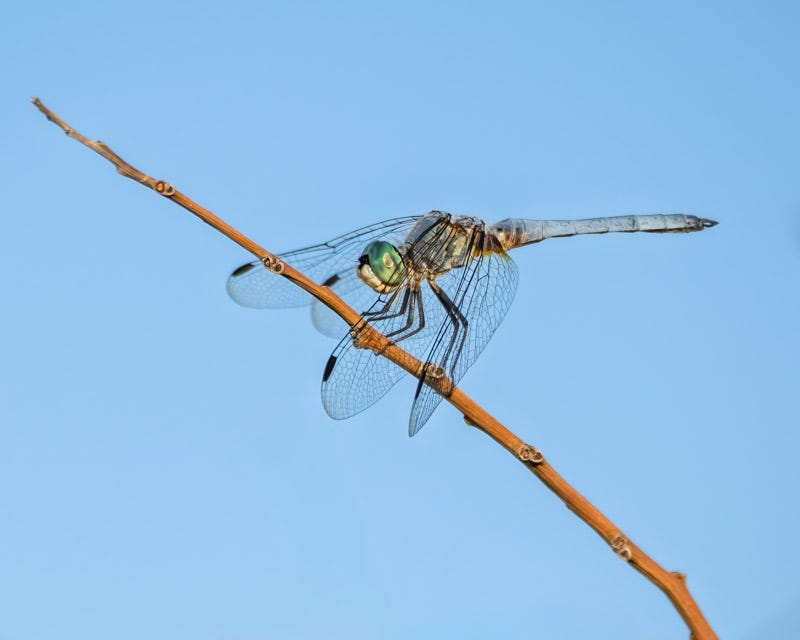
Dragonflies are so attractive thanks to their seemingly effortless flight, their shiny wings, and their bright colors. A number of our common local dragonflies have either some blue or some red in their names. The Blue Dasher is one of the most common dragonflies in the US and is in Tucson in large numbers. Practically anywhere you can find dragonflies, there likely will be a Blue Dasher among them. This medium sized Dragonfly has a powdery blue abdomen, green eyes and a white face.
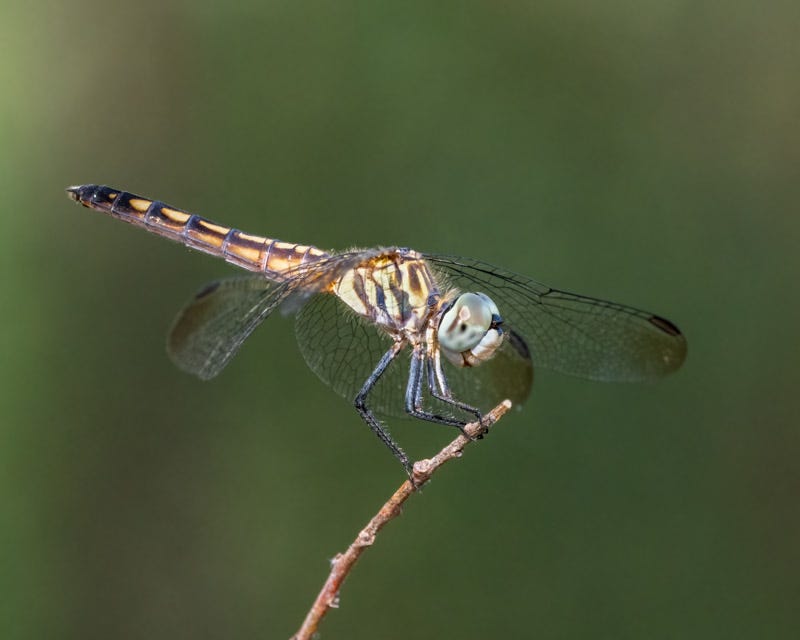
The female Blue Dasher, as with many other female species of Dragonflies, shares its mates’ name but not its colors. The female Blue Dasher is not blue. She does have the green eyes that the male does but she has an abdomen with dark and yellow-ish patterning. Her thorax has diagonal stripes.
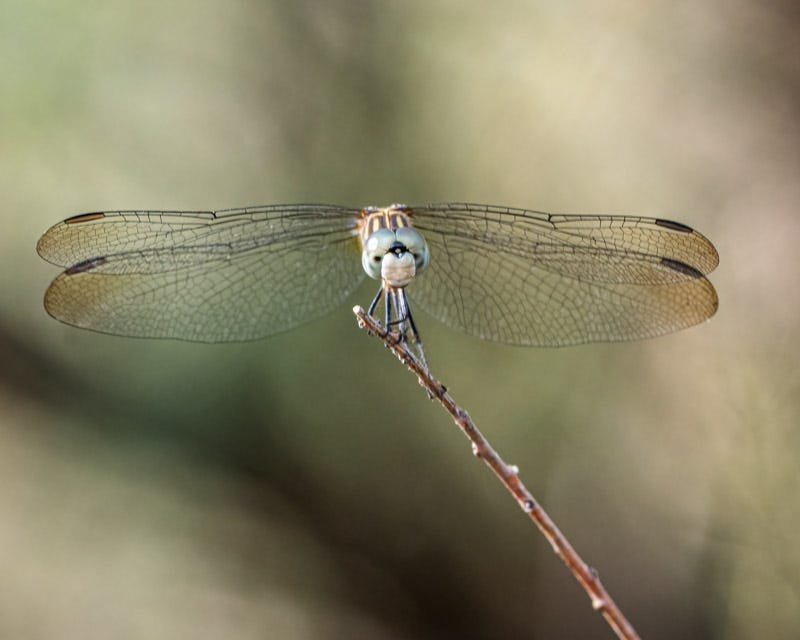
Face-to-face with the female Blue Dasher, her slim body shape is hidden behind the large eyes and thorax. Her wings fill the image.
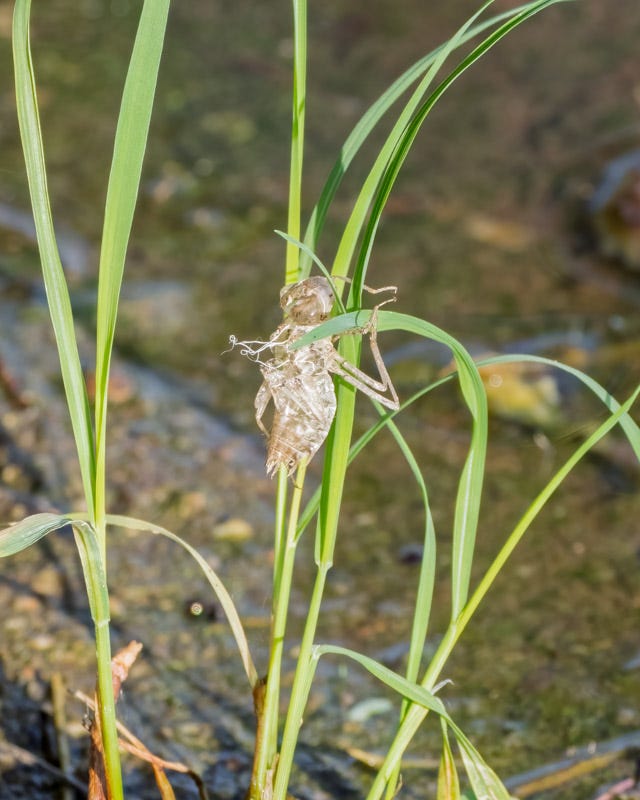
Dragonflies spend almost their entire life in water. Somewhat similar to the larval stage or other insects, dragonflies live as aquatic nymphs, going through a number of distinct molts during their aquatic life. It may take 1-5 years for the nymphs to be ready to emerge from the water. At that time, they’ll crawl out of the water and onto something hard like a plant stem, a rock or stick. Then, their hard outer shell splits and the adult Dragonfly emerges. The dry shell that remains is called an exuvia. That adult that we see flying around may typically live just a few weeks to a few months. Dragonfly experts may be able to determine the Dragonfly species by examining the exuvia, but I sure can’t.
Red Saddlebags Dragonflies are known for the large dark patches on their hind wings. Those patches are said to look like Saddlebags, and so their name! Male Red Saddlebags are, of course, red, but the females aren’t. Saddlebags are known for their endless flight, and rarely are found perched. So when I saw a female Saddlebags sitting still I was excited. After a short while, my excitement lessened when I realized that my good fortune was based on the misfortune of the Red Saddlebags- it was caught in a spiderweb!!
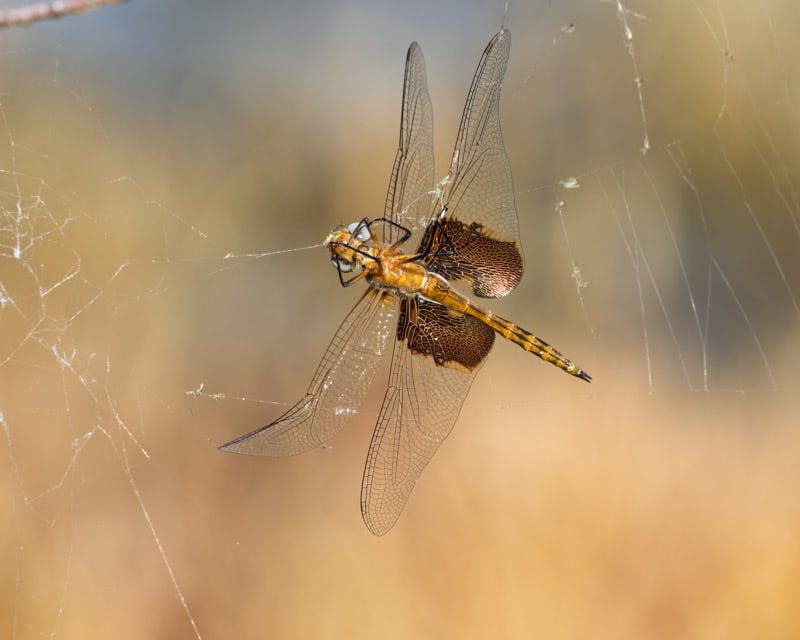
She was still alive, and tried to free herself occasionally, but without success. The web was stretched out across the water so it was beyond my reach. As they say, nature takes its course.
Earlier this summer I was in the Chiricahuas when I came across this Red Rock Skimmer. Red Rock Skimmers are a bright red Dragonfly that can be found perching on sun-warmed rocks and boulders next to streams.
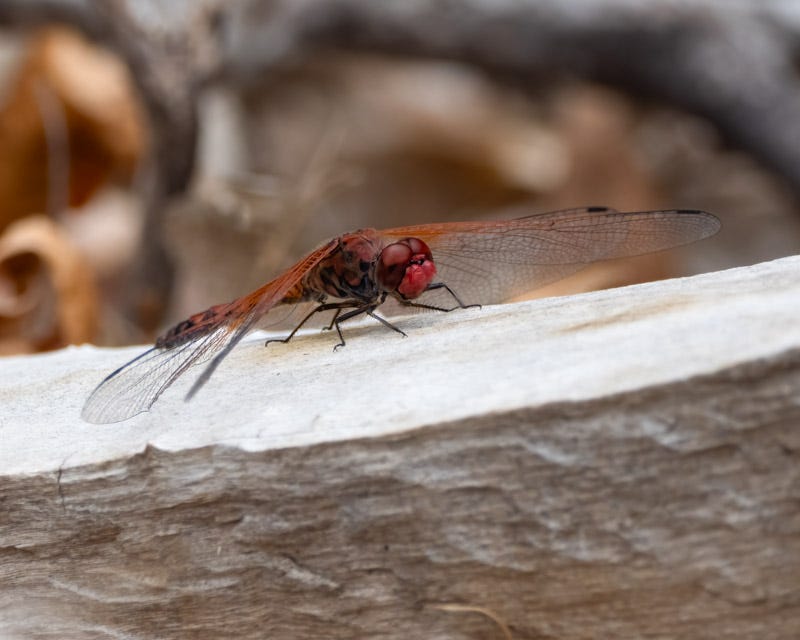
Later that summer, I saw another Red Rock Skimmer warming up on a rock in the creek at Madera Canyon.
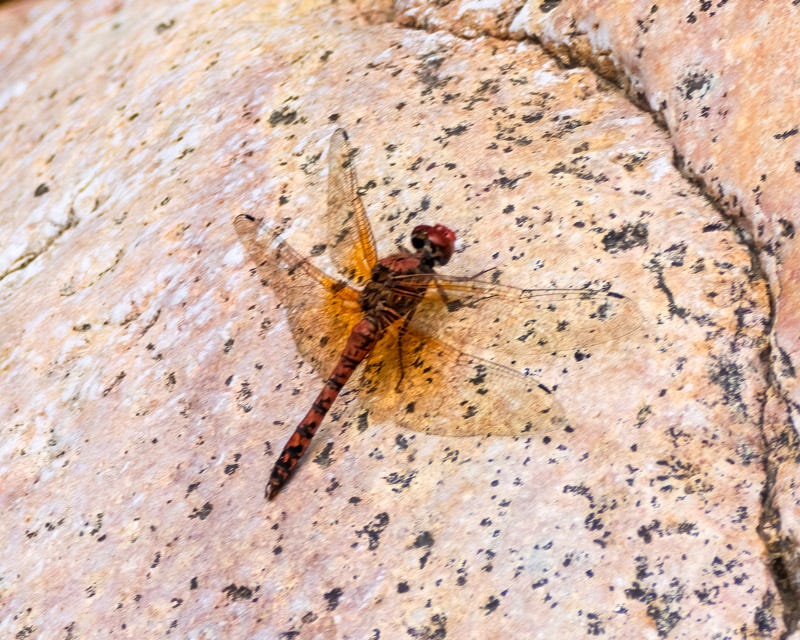
On a recent afternoon, I saw a Roseate Skimmer in a farmfield. Farm fields have irrigation ditches, flooded fields, and runoff that provides the necessary water for these insects. I really liked this one’s perch!
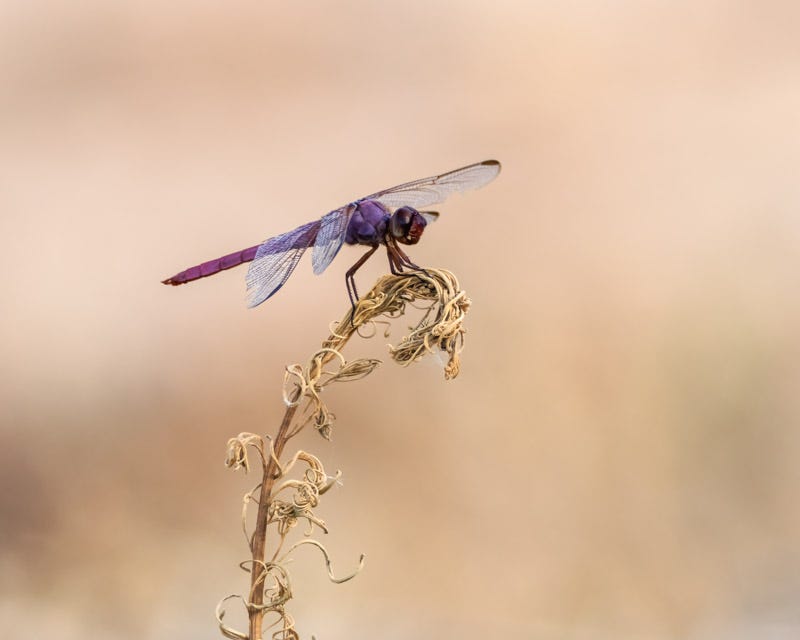
Here’s another look of this Roseate Skimmer from different angle. Behind it the green alfalfa field ends in dry soil.
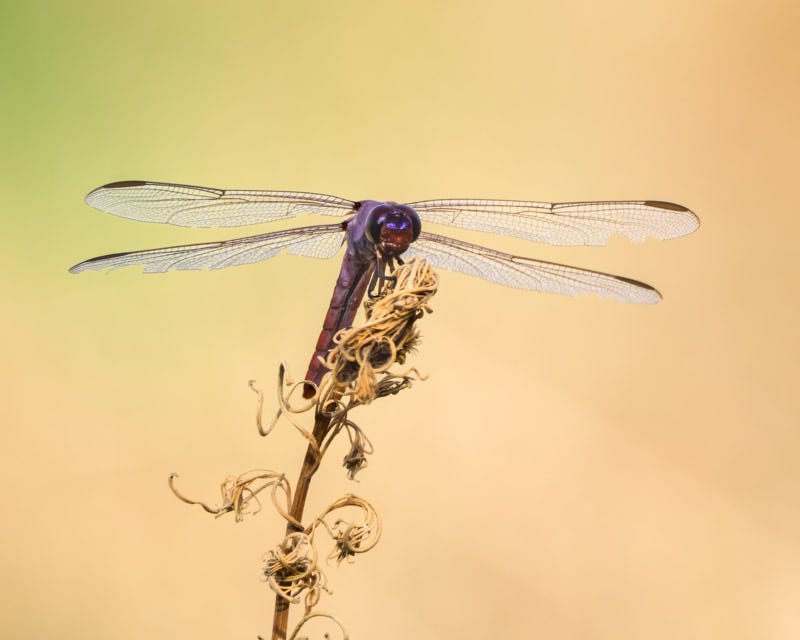
Dragonflies add one more element of color and life to the natural world of our Sonoran Desert.
Dan,
They are almost alien creatures. If they were any larger, they would be frightening!
Nice selection of these beautiful insects! Thanks, as always.
One summer I was outside gardening, and a bright red-orange dragonfly flew right in front of me and perched on a branch. I gasped. It was so beautiful and so unlike any dragonfly I'd ever seen or imagined. A bit of research identified as a male flame skimmer. Southern AZ is such a wonderful place to live!