

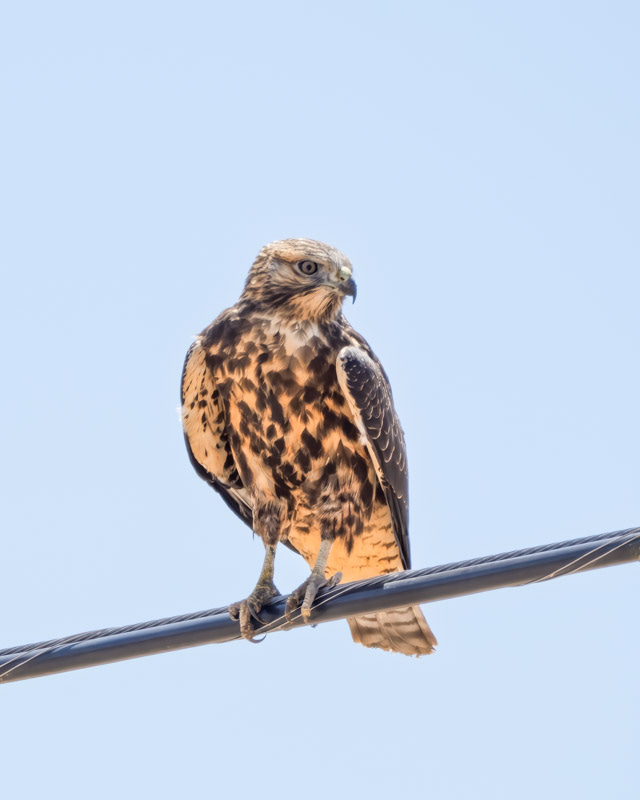
On the final day of July I came across this juvenile Swainson’s Hawk at the northern end of Marana’s farmland. Breeding Swainson’s Hawks are rare in Pima County but can occur in open desert grasslands and agricultural areas as evidenced by the presence of this juvenile. The streaky breast, lack of a bib, and lightly colored eye differentiate this bird from an adult Swainson’s. Still, seeing this bird made me think that the mass migration of Swainson’s Hawks through our area may have begun.
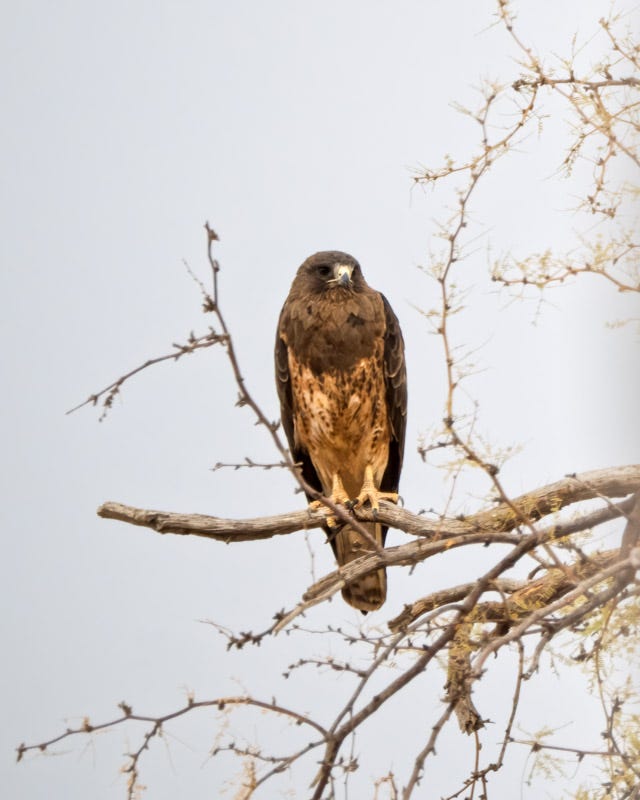
One week later a friend and I drove through extensive farmland in Pinal County, south of Casa Grande, in hopes of seeing some early migrating Swainson’s. Once we turned off of I-10, we almost immediately spotted this adult Swainson’s Hawk perched in a mesquite tree. Adult Swainson’s Hawks weigh between 2-2.5 pounds and this bird sat lightly on a small twig at the top of the tree.
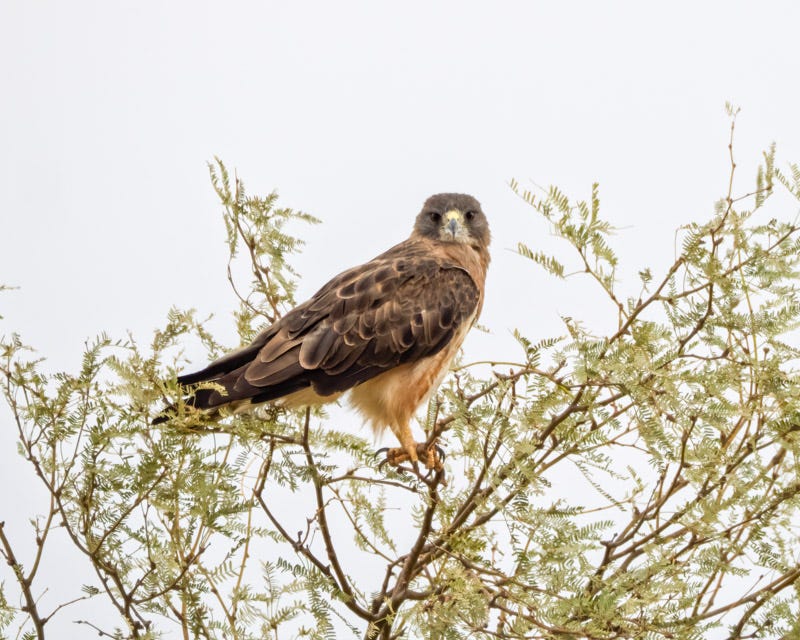
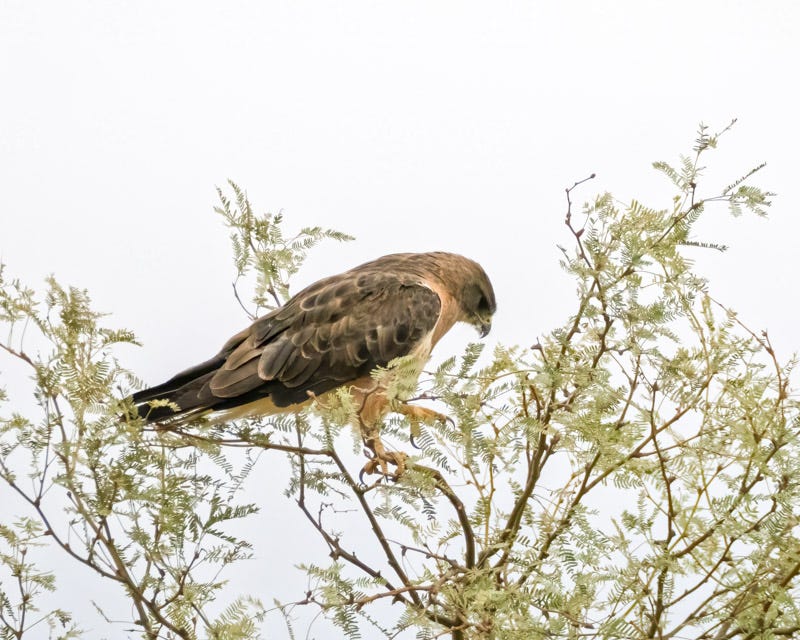
We remained in the car on the farm road and the Hawk watched us for a long time. Eventually, it began to switch its stance. You can see the twig bending to this action. (I last reported on Swainson’s Hawks migrating south through our area one year ago in August, 2025. You can revisit those two posts here and here.) Was this Swainson’s a sign that this year’s migration has begun?
After minutes of rousing and stretching, the Hawk took off! Looking at this bird’s plumage and comparing it to the first bird in this post, you can see what a typical adult Swainson’s Hawk looks like. There is a ‘bib’ on the upper half of its breast that the juvenile did not have. You can also see the dark eye of the adult compared to the lightly colored eye of the juvenile.
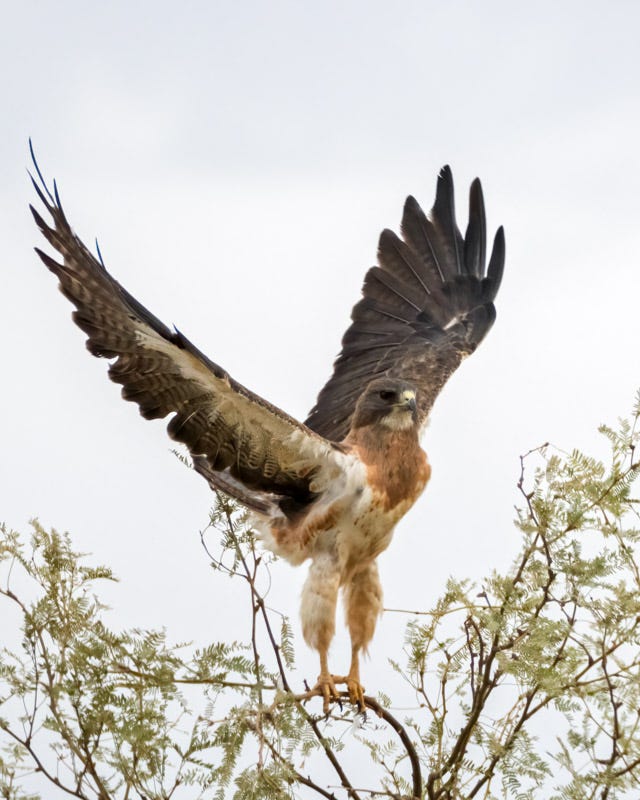
After reaching up high, the Hawk begins to lower its wings in a powerful sweeping push. Swainson’s Hawks have light wing linings on the front edge compared to the darker flight feathers on the back of the wing.
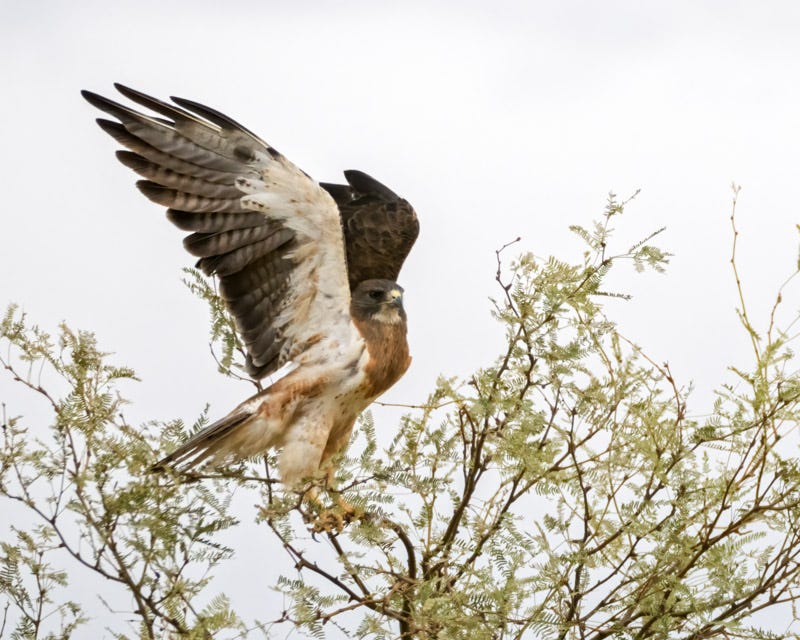
Lift-off!
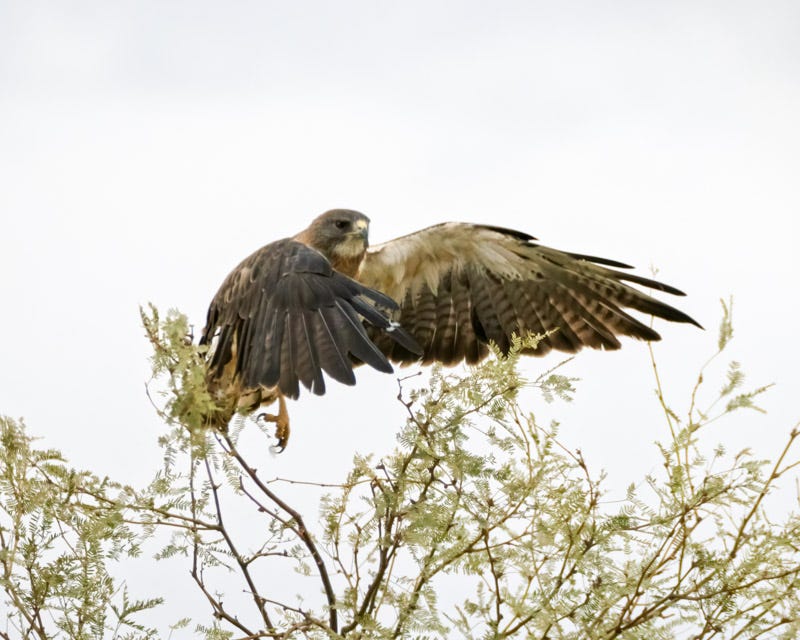
Forward flight began. Was this bird leaving us? Was it alone or part of a larger group? The Swainson’s Hawk flew forward and then turned to its left, disappearing behind the neighboring mesquite trees.
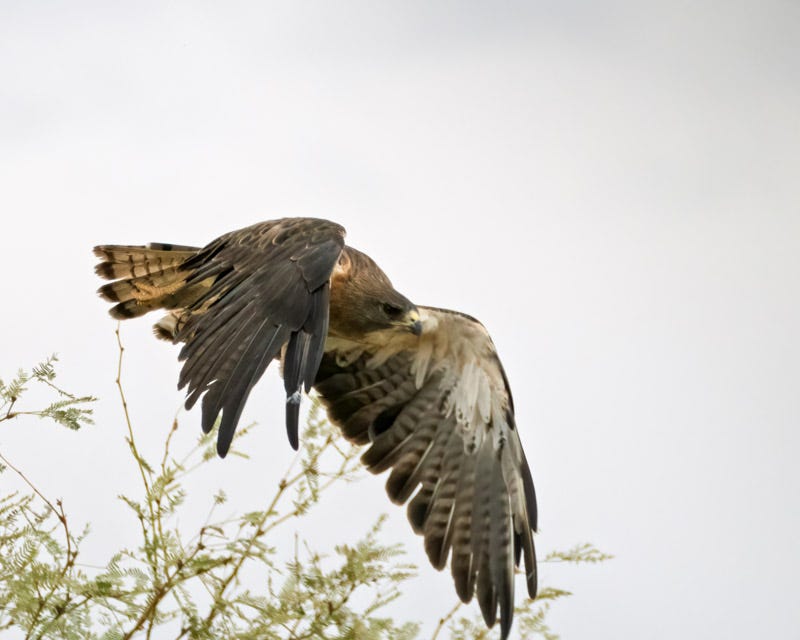
We drove forward a bit and saw that our Swainson’s had landed nearby, joining another Swainson’s Hawk. Swainson’s Hawks summer in western and central North America, ranging through Canada and all the way up to Alaska. They winter in the Pampas grasslands of South America, mostly in Argentina. They migrate an incredibly long distance but travel only 100 miles per day. It was too early in the morning for our bird to begin today’s migration journey and it was likely still tired from yesterday’s long flight.
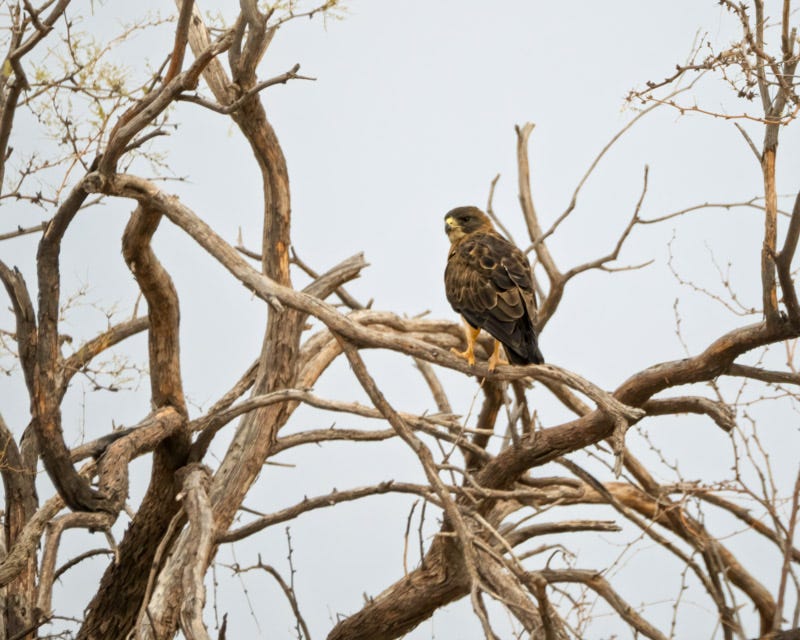
A second Swainson’s Hawk was peacefully perched on the opposite side of the same mesquite tree.
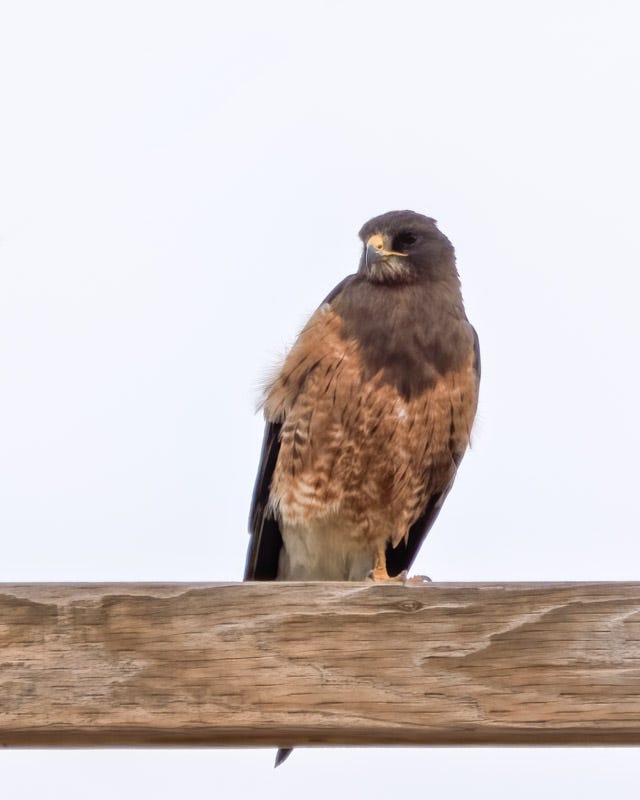
A mile or so beyond these two Hawks we saw a small flock of Swainson’s in the first farm field we drove by. They were too distant to take photos of but the birds were all perched on the ground in the field. While Swainson’s prefer to perch in trees, in wide-open landscapes like prairies or agricultural fields Swainson’s will perch on the ground. Later on, we saw one final Swainson’s Hawk on a telephone pole. It was very relaxed with one leg tucked up under its feathers.
For another description of what we saw that hot summer morning, take a look at my friend’s blog called Sonoran Images. It’s still hot in Tucson but Autumn is just around the corner!
If you are interetsted in learning more about the birds migrating overhead in your area tonight, check out Cornell Lab’s Migration Dashboard. The BirdCast’s project is truly fascinating and you can read about it here.
Very fun to see the similarities and differences between your post and that of your friend!
Wonderful capture and text!