

I am always happy to see these birds
In the book “A Most Remarkable Creature”, author Jonathan Meiburg introduces Caracaras with “...if you try to imagine ten separate attempts to build a Crow on a Falcon chassis, with results falling somewhere between elegant, menacing and whimsical, you wouldn’t be far off.” Then he adds: “All have broad wings, hooked beaks, and an alert, curious expression.” He finishes with, “Their most striking qualities, however, are their minds. Unlike most birds of prey, Caracaras are social and curious, and they feed with gusto on foods other predators disdain.”
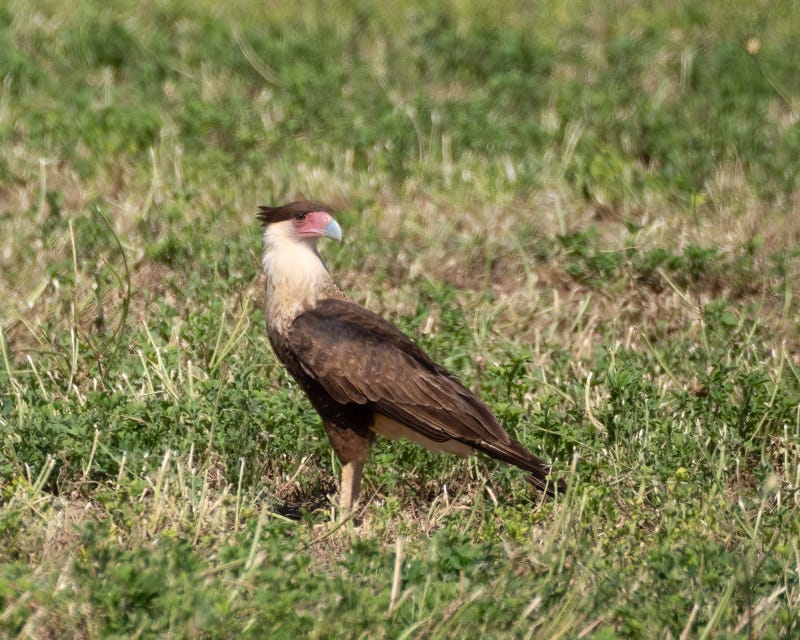
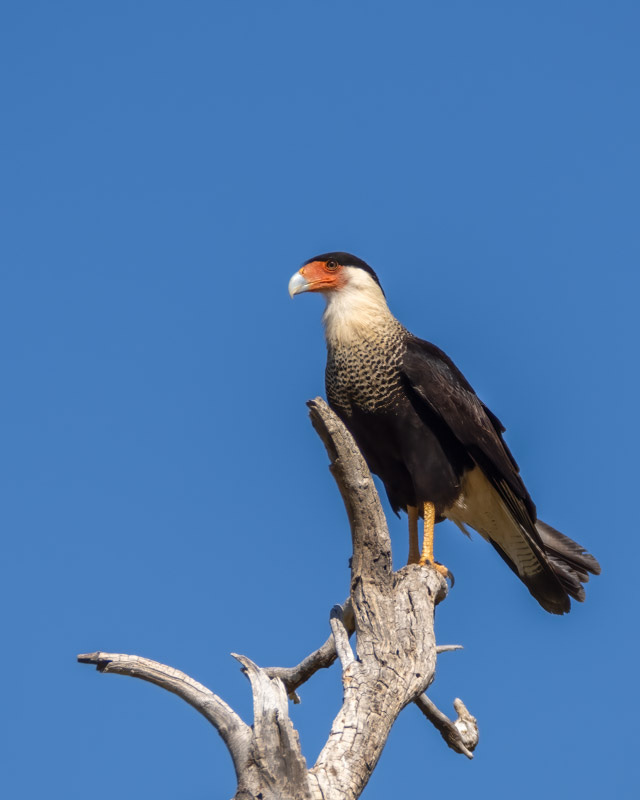
Immature Crested Caracas take a few years to develop the white and black feathers seen on the adult above. The bird below shows brown feathers and a dusty neck. The bare facial skin is still pink but will become orange as it ages.
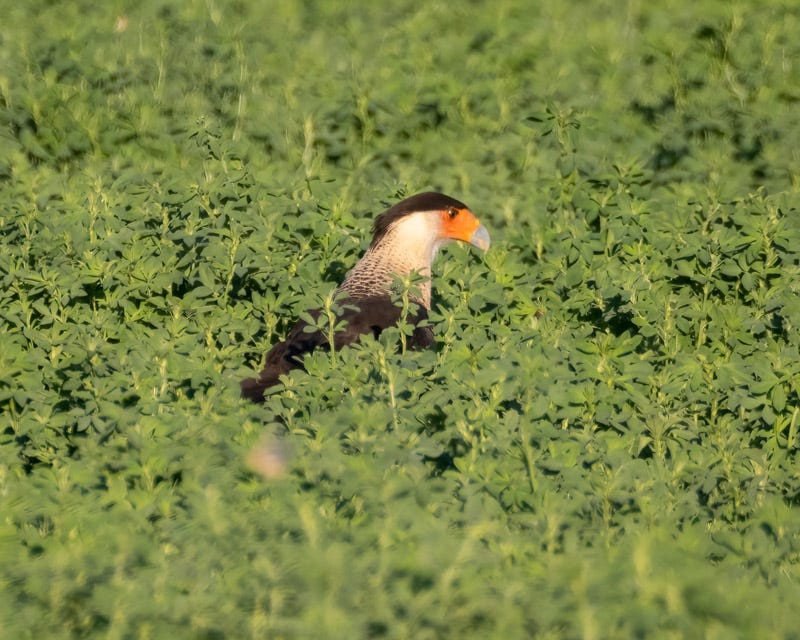
The Crested Caracaras wandered through the farm fields where the alfalfa is almost tall enough to be harvested. These birds stand about two feet tall. Crested Caracaras are scavengers and opportunists. They will eat whatever is easiest to find or catch and they were in search of food.
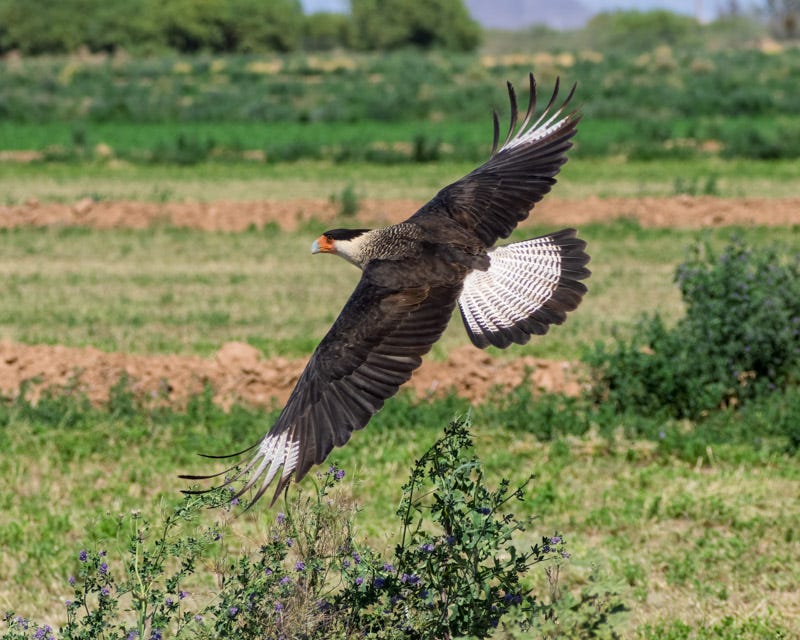
Although Crested Caracaras are in the Falcon family, they are not fast flyers like all the other Falcons are. They evolved to be a more specialized, ground-based bird. They have broader wings than Falcons and are strong but deliberate flyers. I like to describe these birds in flight as having white on their four corners, seen below.
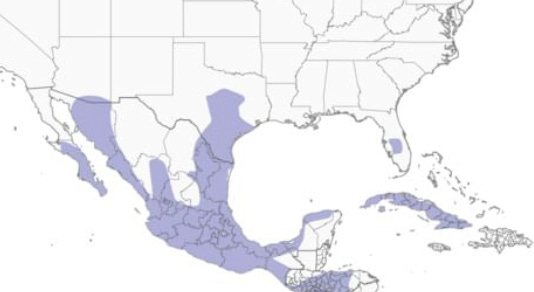
If you want to see Crested Caracaras anywhere in the US, you need to come to southern Arizona or southern Texas. Those populations are continuous with breeding populations further south and they range all the way through South America. There is also an isolated group of Crested Caracaras in central Florida. (Map courtesy of AllAboutBirds)
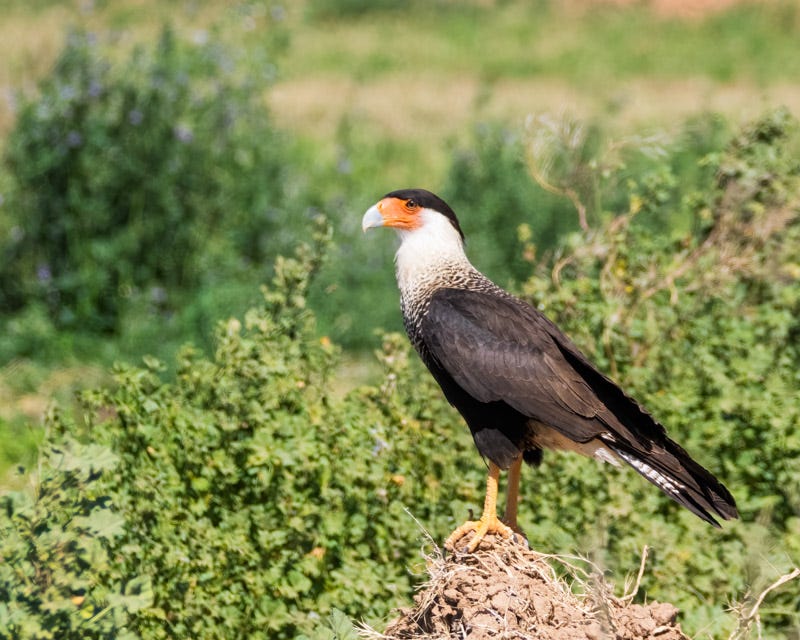
Although they spend quite a bit of time on the ground, the Crested Caracaras will also perch high to survey the landscape. You can see their rather large head as it perches upright.
I’ve always liked this description of Crested Caracaras in the Tucson Bird Alliance article by Matt Griffiths: “The Crested Caracara looks like a hawk, often acts like a vulture, and is technically a large, tropical falcon.” As the author Meiburg says, they truly are a remarkable creature.
An interesting feathered friend that I knew nothing about. Love learning and thankyou for sharing!
Currently birding with friends in Texas and New Mexico. Had some wonderful sightings of these birds. I will look for the pink facial skin of the young thanks for that hint.